
We published an explainer on TypeSafe Jev on 19 September, four days after launch, covering what a decision model is, how its Choice, Score and Noul questions work, and how to call it through Requesty. This post is about what happened next. Our public post tracker logged 1,316 X and Reddit posts from 965 distinct authors naming Jev between the 15 September launch and midday on 22 September. That is not a spike. Daily volume went 7, 42, 115, 268, 285, 251, 281 and then a 67 post half day, and the Reddit share climbed from 1 post to 76 as builders moved from reacting to shipping.
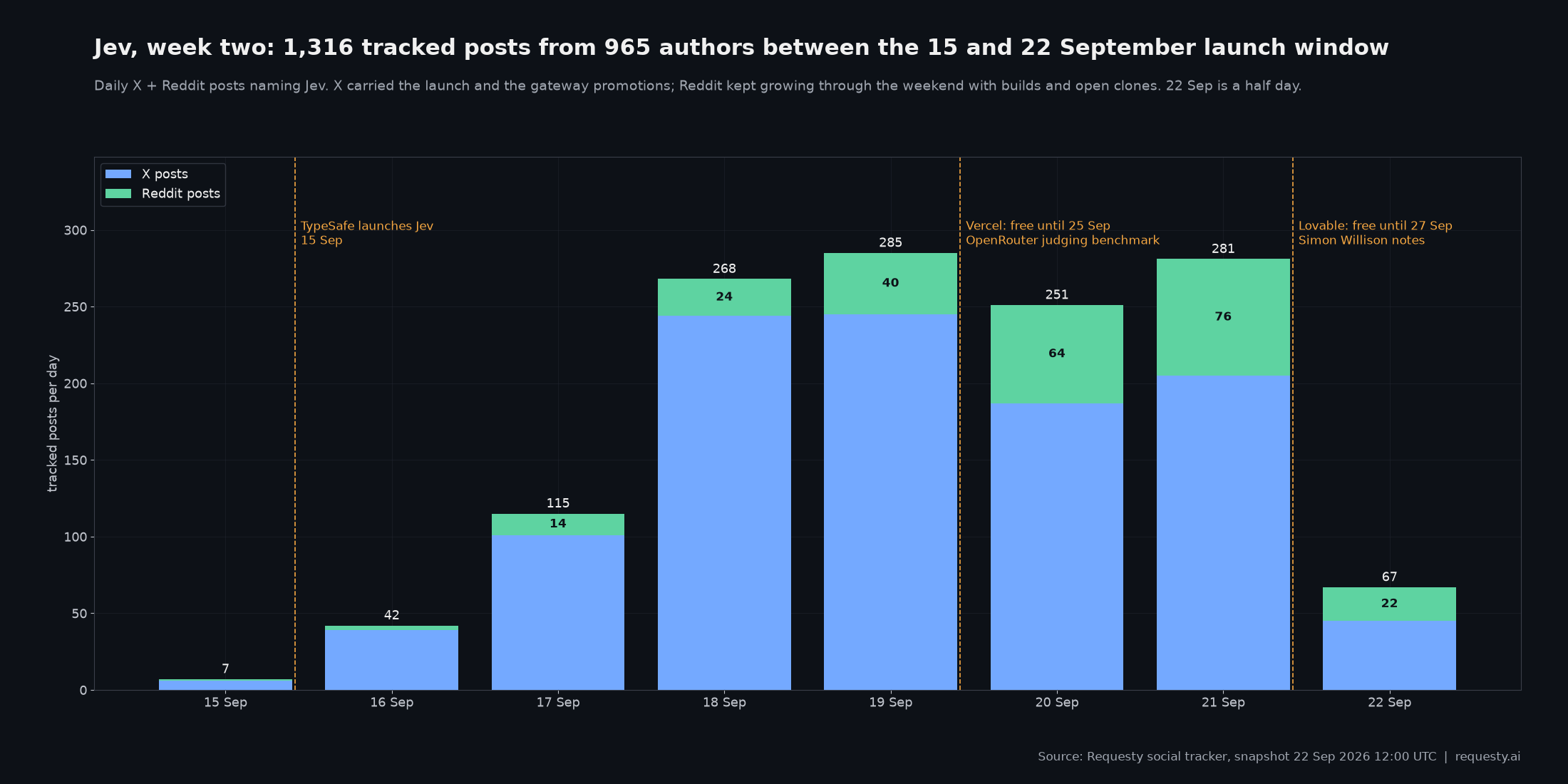
The week produced three things worth a production team's attention: a gateway price war on a model that costs $0.042 per million tokens, a set of concrete integration patterns from builders who had nothing to sell, and the first open weight imitations. It also produced the first sharp criticism, which we cover because it points at the evaluation gap every buyer should close before depending on a decision model.
Four gateways, two free windows, one price
Jev is a small model with a tiny bill, so the competition to host it has been about distribution rather than margin. Within a week:
- Vercel put Jev free on its AI Gateway until 25 September, calling it "the fastest adopted model on the Gateway." That post did 2,899 likes, 2,251 bookmarks and 1.07 million impressions, the largest single Jev post of the week. Guillermo Rauch followed with HTTP access to Jev alongside the SDK route.
- OpenRouter benchmarked it against popular LLMs on a judging task using its eval tool: "Jev was more than 5x faster than the next fastest model, and even its slowest requests beat every other model's median." 965 likes, 58,600 impressions.
- Lovable added Jev to its AI Gateway free through 27 September 23:59 UTC.
- Cline shipped a browser plugin driven by Jev, with setup instructions that route through a Vercel AI Gateway key. 690 likes, 538 bookmarks.
Requesty serves Jev at TypeSafe's list price of $0.042 per million input tokens and nothing for output, at typesafe/jev-1.13.0, with the questions response format documented in the Decisions guide. At this price a hundred million decisions cost $4.20, so the free periods are about getting a key into your hands before 25 or 27 September, not about the money.
Two things to note about that. First, every free window above has a published end date, and we wrote about why free model ids now ship with expiry dates after the August wave of promotional inference. Pin the paid route in your config before the window closes. Second, one 46,000 follower builder put the sharper version of the pricing objection in a reply: the problem with most model routers is that you are "stuck paying api pricing," and a 30% saving on API rates is still ten times what a subscription costs. He was talking about routing subscription tier models through Jev, which is a real use, but the objection applies to Jev itself: at $0.042 the model is not where your bill is, and a router earns its place by what it does to the LLM calls around it.
What builders shipped
The demos in our first post were day one prototypes. Week two produced tools other people are installing. The pattern in all of them is the same: find the step in an agent loop that used to cost a full LLM reasoning call and does not need one.
Permission gating. Jevvy auto approves routine OpenCode permission prompts "using calibrated probabilistic review," reviewing only the shell requests OpenCode would otherwise ask about. It was the top Jev thread on Reddit all week at 32 upvotes, shipped 0.3.0 with support for OpenCode Zen, TypeSafe, OpenRouter, Vercel AI Gateway and custom endpoints, and added Claude Code on 21 September. Elvis Saravia, 320,000 followers, described the same thing from his own harness: "most demos on my timeline are flashy but very basic," the value is in the boring gate.
Browser action selection. Hunch takes the accessibility snapshot from a browser, sends it to Jev, and gets the operation and target element back in "one ~150ms request." The author's framing is the clearest statement of the pattern we saw: "most steps a browser agent takes are not hard. type the email, type the password, click sign in. but every LLM agent pays a full reasoning call for each one." It sits under an existing agent and exits with a structured report when confidence drops or a click looks irreversible.
Context compaction. A Hermes Agent plugin uses Jev to decide which old tool call results to drop from a long session, claiming 75% context reduction against 55% for the stock summariser while keeping every user and agent message verbatim. Selection instead of summarisation is a job a decision model is shaped for.
Judge replacement, with a control. JevArena lets you pose a judging question, pick any OpenRouter model as the comparison, vote blind, then reveal judgment, latency and cost. Its author's motivation is the one we would recommend to anyone: "Jev is fast, but speed isn't the whole question. where does it agree with stronger models? where is it confidently wrong?" JevGraph applies the same idea to relationship extraction for knowledge graphs, with a frozen 160 case test set from FewRel.
Simon Willison published notes on Jev and "the new category of system one aka decision models" on 21 September; at 918 bookmarks it was the most saved Jev post of the week, which tells you where the developer audience is: past the demos, reading the manual.
X talked gateways, Reddit talked evals and clones
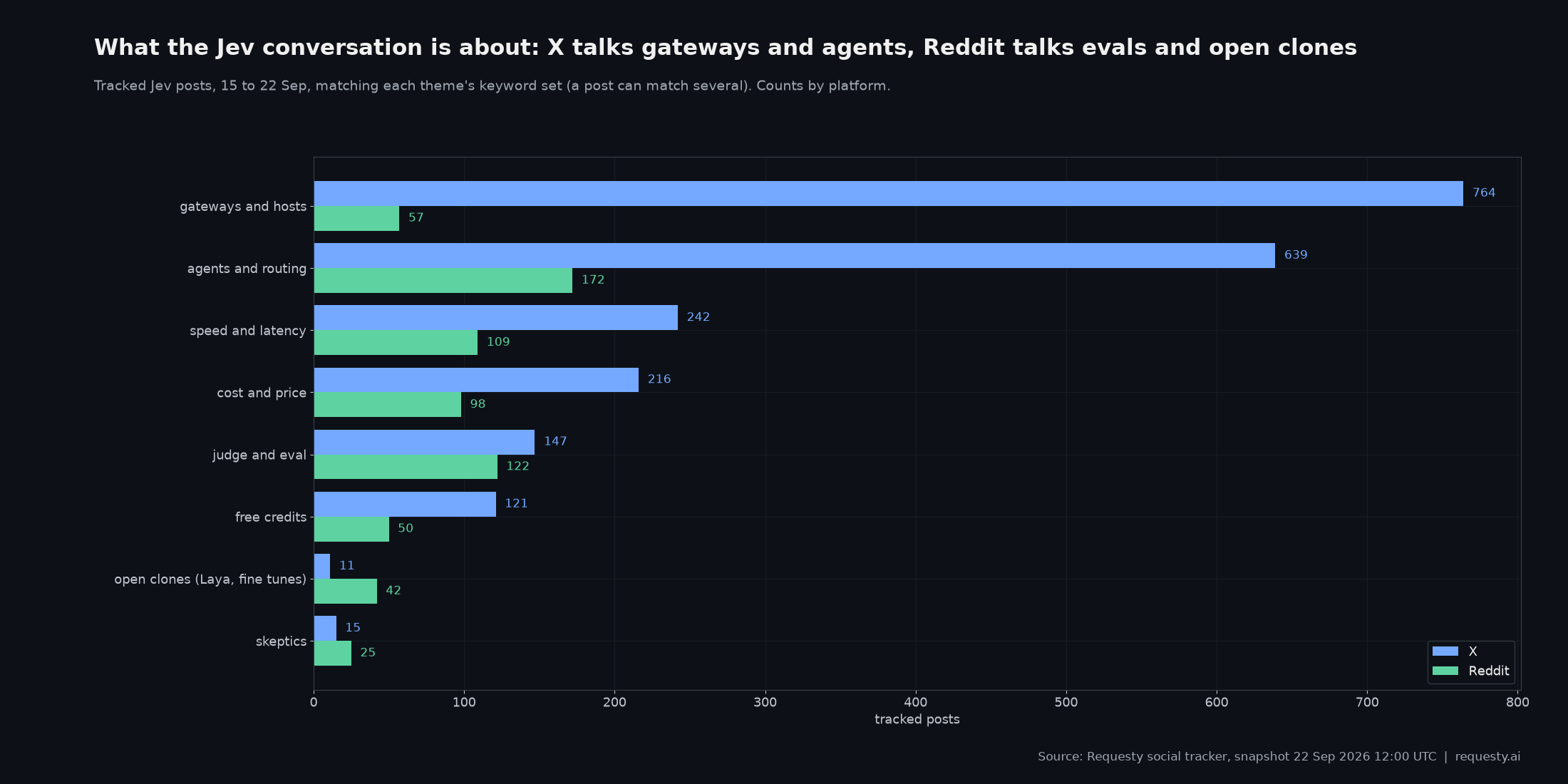
The theme split above is the most useful chart in this post if you are deciding whether to care. On X, 764 of the Jev posts mention a gateway or host and 639 mention agents or routing: the platform conversation was about distribution and integration. On Reddit the ratio inverts on the themes that matter for a buyer. Judge and eval posts run 122 on Reddit against 147 on X despite Reddit having a fifth of the volume. Open clones and fine tunes run 42 to 11. Skeptics run 25 to 15.
That Reddit corner produced three open weight imitations in a week:
- Laya, from a builder who says he published the same architecture a year ago, then trained an improved model on a single RTX 6000 Pro: 421M parameters, a bidirectional ModernBERT large encoder with a transformer head that scores typed option markers in one 35 ms forward pass, trained on 25,000 human annotated examples. He claims it surpasses TypeSafe's published Jev benchmarks. A C++ port appeared two days later.
- A Qwen3.5 4B LoRA, trained for two hours on a rented RTX 3090 on 25 million tokens of synthetic decisions generated by DeepSeek V4.1 Flash, moving the base model from 0.596 to 0.709 on a typed decisions set. The author calls it "nowhere near Jev yet" and shipped a Jev compatible API endpoint anyway.
- A decisions route on Qwen3.8 27B via ninfer, measured against a community JevBench of 231 typed decisions: "latency is not great but accuracy is almost on par."
None of these has independent evaluation and we are not endorsing any of them. The point is structural. A week after launch, the request shape (state in, typed probabilities out) has three open implementations, one of them a fraction of a gigabyte. Whatever TypeSafe's moat turns out to be, it is not the API contract, and a team that codes against that contract through a routing layer keeps its options open on the model behind it.
The criticism worth taking seriously
The loudest skeptic thread, Guys Jev Is a Scam, argued from a single geopolitical question that Jev is a relabelled Chinese model. Nine comments, zero upvotes, and the evidence does not support the conclusion. But the underlying test is one every buyer should run: ask the model a question where you know the right probability, and see whether it returns a calibrated 50% or a confident wrong answer. A more measured thread asked whether Jev is "a more generalised BERT," which is close to what the Laya author built in response, and is a fair way to think about the class.
Matt Shumer, 395,000 followers, asked the question we would ask: is anyone trying Jev for scalable oversight, as a check on whether a larger model is behaving. That is the highest value use of a cheap, fast, calibrated judge and also the one where a confidently wrong answer costs the most.
How to evaluate a decision model for your pipeline
Our recommendation is unchanged from the explainer, sharpened by a week of watching builders do it well and badly.
- Pick one decision that currently costs an LLM call. Permission gating, routing to a model tier, drop or keep for context, relevant or not for retrieval. Jevvy and Hunch are good templates because the decision is bounded and the failure is recoverable.
- Build the control before the swap. JevArena's blind comparison against a stronger judge is the right shape. Log the decision Jev makes alongside the one your current model makes for a week, then look at the disagreements.
- Measure calibration, not just accuracy. Bucket the returned probabilities and check that decisions Jev scores at 80% are right about 80% of the time on your data. This is the test the "scam" thread was fumbling toward, and it is the property that lets you set a confidence threshold for human review.
- Pin the version and route through one place. Jev is
typesafe/jev-1.13.0on Requesty; aliases move. With five hosts and three open clones speaking the same contract, a routing policy with a fallback gives you a place to switch hosts, compare an open clone against the original, and see the decision in the same logs as the LLM call it replaced. We covered how routing policies for agents work if you have not set one up. - Count the tokens you stopped spending. The bill for Jev itself will be a rounding error. The saving is the reasoning calls it removed, and you can only see that if the same gateway metered both before and after. Our usage analytics split spend by model and key for exactly this comparison.
To try it, create a Requesty key, follow the Decisions guide, and start with the permission gate. If the two week plateau in the chart above holds, this is a model category rather than a launch week, and the teams that measured it first will know which of their LLM calls never needed an LLM.
Methodology
Post counts come from our public post tracker, which polls X and Reddit for model and gateway conversation every ten minutes and matches Jev by word boundary regular expression; the window is 15 September 00:00 to 22 September 12:00 UTC. Theme counts match each post against a keyword set per theme, and a post can match several. Engagement figures for quoted X posts were refetched from the X API on 22 September at 12:30 UTC. Reddit scores are as captured by the tracker and lag the live thread. Claims about Laya, the Qwen fine tunes, Jevvy, Hunch and other community projects are the authors' own and have not been independently verified by us.
Frequently asked questions
- Where can I use TypeSafe Jev for free?
- As of 22 September 2026, Vercel AI Gateway offers Jev free until 25 September and Lovable AI Gateway until 27 September 23:59 UTC. TypeSafe gives new accounts $5 in credits. Paid list price is $0.042 per million input tokens with no output charge, and Requesty serves it at that price as typesafe/jev-1.13.0. Every free window in this list has a published end date, so pin the paid route before you depend on it.
- What are people building with Jev?
- The builds our tracker picked up in week two cluster into four jobs: agent permission gating (Jevvy auto approves routine OpenCode and Claude Code prompts), browser action selection (Hunch picks the next click from an accessibility snapshot in about 150 ms), context compaction (a Hermes plugin that decides which old tool calls to drop), and LLM as a judge replacement (JevArena and JevGraph). The common thread is a decision that used to cost a full LLM call and now costs a single small request.
- Are there open source alternatives to Jev?
- Three appeared on r/LocalLLaMA in the first week. Laya is a 421M parameter non autoregressive decision model trained on a single RTX 6000 Pro, with a ModernBERT encoder and a 35 ms forward pass, and its author claims it surpasses TypeSafe's published Jev benchmarks. A second builder LoRA tuned Qwen3.5 4B on synthetic decisions for two hours on a rented RTX 3090 and published a Jev compatible endpoint. A third exposed a Jev style decisions route on Qwen3.8 27B. None has independent evaluation yet.
- Should I put a decision model behind a gateway or call it directly?
- Behind a gateway if you have more than one provider for it or if you already route your LLM calls that way. Jev is now available on at least five routes (TypeSafe, Requesty, Vercel, OpenRouter, Lovable) at different prices and different free windows, and the first open weight imitations expose the same request shape. A routing layer lets you pin a version, fail over between hosts, and log the decision alongside the LLM call it replaced, which is how you find out whether the swap paid off.
- SEP '26
TypeSafe Jev explained: how it works, LLM differences and API pricing
A practical guide to TypeSafe's decision model, what its probabilities mean, and how to access Jev through Requesty.
- SEP '26
Open weight models are 55% of our tokens and 15% of our spend: what the 78.4% Vercel number does and does not tell you
On 19 September Vercel reported a record 78.4% of AI Gateway token volume going to open models. The number went viral, then got called nonsense by one of the most followed infrastructure builders on X. Both sides have a point. Here is what our own gateway shows when you split the same traffic three ways: tokens, requests and dollars.
- SEP '26
Grok 4.7 and MiMo-V2.6 Pro launched four hours apart with the same benchmark score: one costs a fifth per token and a twenty fourth per eval
SpaceXAI shipped Grok 4.7 at 16:17 UTC on 21 September and the announcement did 12.3 million impressions. Xiaomi shipped MiMo-V2.6 Pro and Flash four hours later and took the evening. Artificial Analysis scores both flagships 46 on its Intelligence Index. Grok 4.7 lists at $2 in and $6 out; MiMo-V2.6 Pro at $0.435 and $0.87. Running the same benchmark cost $4,967 on one and $207 on the other. Here is why the gap is bigger than the price list says.
- AUG '26
Free model IDs now ship with expiry dates: how to use promotional inference without building on sand
In one week: a stealth model gave away 20 trillion tokens then vanished, Thinking Machines put Inkling on OpenRouter free for a few weeks, MiniMax opened M3 and M2.7 free until 6 September, and Z.ai handed 50,000 developers 100M tokens each. Free inference is now a marketing channel with a calendar. Here is how to consume it without a production incident.
- JAN '26
Routing policies 101: fallback, load balancing, and latency in production
The three routing-policy primitives every LLM gateway needs (fallback chains, weighted load balancing, and latency-based selection) and when to use each. Written for teams deploying multi-model production setups.
- JUL '26
Do provider native tools still work through an LLM gateway?
Web search, Gemini grounding, file search, MCP, prompt caching, reasoning tokens. The most repeated gateway question of the week, answered feature by feature with what passes through, what needs a flag, and what does not.