
OpenAI released GPT-6 Sol and GPT-6 Luna on September 22, 2026. At Standard API rates, Sol costs $2 per million input tokens and $10 per million output tokens. Luna costs $0.10 and $0.50 respectively. Both accept text and images and return text.
The prices are worth noticing. But for anyone building with these models, the more useful question is what we get for that lower spend. Can Luna handle work that previously needed Sol? Does the upgrade reduce the time spent correcting an answer? And how much of the advertised saving survives once we account for reasoning, caching and the service tier?
Let's work through the changes, the pricing comparison with GPT-5.6, and how to access both models through Requesty.

Please welcome GPT-6 Sol and GPT-6 Luna to the GPT-6 universe. GPT-6 Sol and Luna build on the advances behind GPT-6 Astra, bringing much of its strengths into faster and more affordable models to support work at scale. We’ve also made caching and inference more efficient, and Show more
What are GPT-6 Sol and GPT-6 Luna?
Sol and Luna occupy different positions in the GPT-6 family. OpenAI positions GPT-6 Sol for demanding coding and agent workflows, while GPT-6 Luna targets focused, high-volume work. GPT-6 Astra remains the highest-capability option.
That distinction is a starting point for evaluation, not a rule that every coding task needs Sol. A well-specified change to a small function and an ambiguous refactor across a codebase ask very different things of a model.
| Specification | GPT-6 Sol | GPT-6 Luna |
|---|---|---|
| OpenAI API model ID | gpt-6-sol | gpt-6-luna |
| Context window | 1,050,000 tokens | 1,050,000 tokens |
| Maximum output | 128,000 tokens | 128,000 tokens |
| Native input / output | Text and images / text | Text and images / text |
| Reasoning effort | none, low, medium, high, xhigh, max | Same |
| Default reasoning effort | medium | medium |
Specifications come from OpenAI's GPT-6 Sol and GPT-6 Luna documentation. Native image input does not mean native image generation.
GPT-6 vs GPT-5.6: what changed?
Better results, not a bigger context window
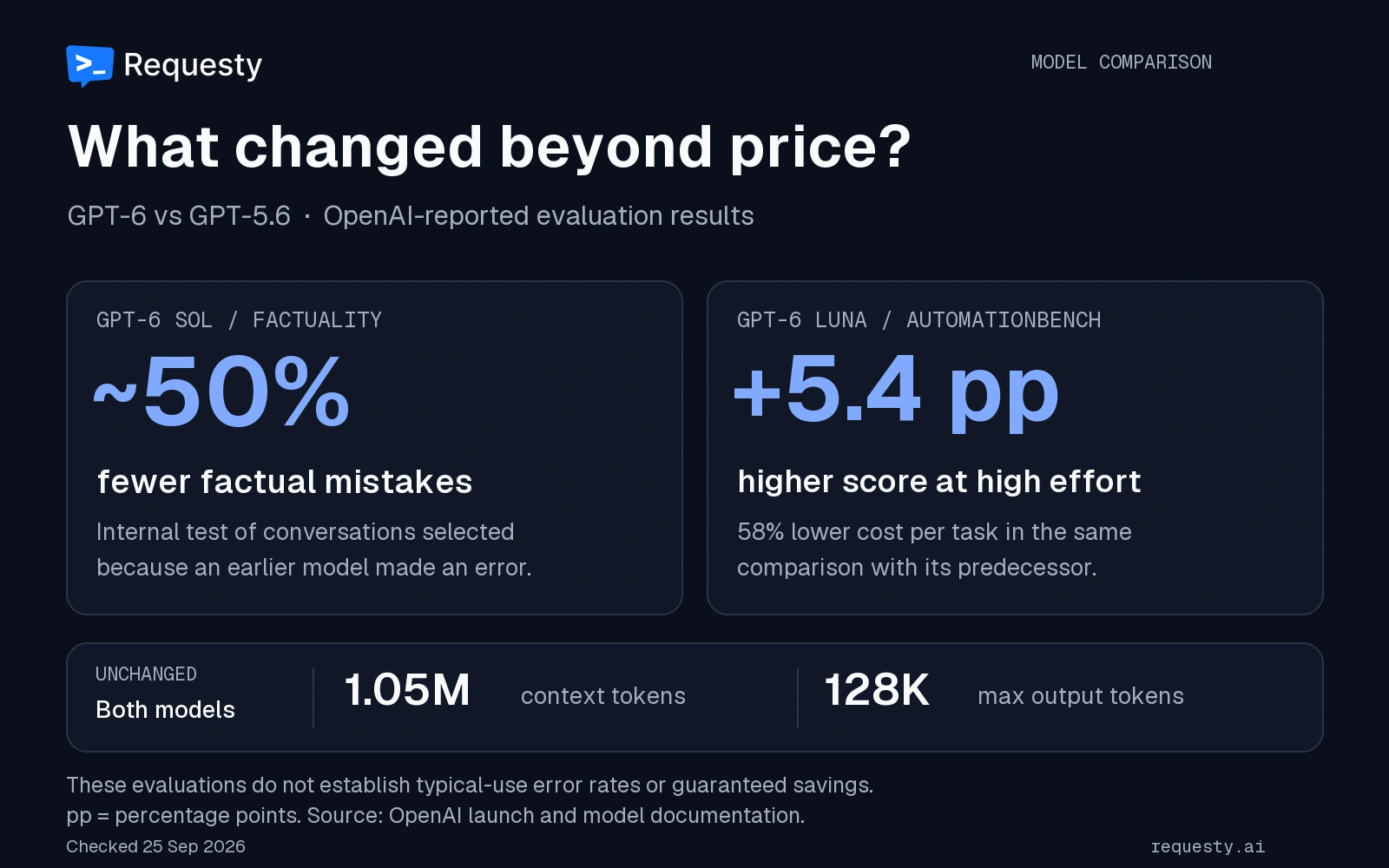
The context window and maximum output are unchanged from GPT-5.6 Sol and GPT-5.6 Luna. Both generations support 1.05 million tokens of context and up to 128,000 output tokens. The upgrade is about the quality and economics of the work, rather than simply fitting more material into a request.
OpenAI reports that GPT-6 Sol makes approximately half as many factual mistakes as GPT-5.6 Sol on its internal factuality evaluation. That test uses conversations selected because users had flagged earlier errors. It is not representative of ordinary usage, so we should not turn that result into a promise that every application will see half as many mistakes.
For a document-review workflow, give both models the same material, then measure unsupported claims and the corrections a reviewer still needs to make. A better benchmark result is a reason to run that test, not a substitute for it.
Stronger coding and business workflows
On AutomationBench, OpenAI reports a 5.4 percentage-point improvement for GPT-6 Luna at high reasoning effort over its predecessor, at 58% lower cost per task. It also reports stronger GPT-6 Sol performance on FrontierCode, which considers whether code changes are suitable to merge, not just whether they pass a correctness check.
A patch can technically work while introducing unnecessary changes, weak tests or a maintenance burden. When evaluating a coding model, include those costs rather than measuring only whether the first response looks convincing.
OpenAI also describes clearer communication and improvements in alignment evaluations, including fewer misleading statements about completed coding work. These are reported improvements, not guarantees that verification is no longer needed.
More control over long-running agents
OpenAI's GPT-6 API guidance describes asynchronous tool calling, mid-turn steering and changes to reasoning effort that preserve the cached prompt prefix. An agent can continue independent work while a tool runs, receive updated instructions during a response, or use more reasoning for a difficult follow-up without rebuilding the shared prefix. These capabilities require the appropriate API integration; changing a model name alone does not implement them.
Alongside the launch, OpenAI detailed improved prompt caching, cache-miss diagnostics and explicit breakpoints that let developers choose where reusable context ends. The current caching documentation covers GPT-5.6 and later, so these controls are not all exclusive to GPT-6.
GPT-6 Sol and Luna API pricing
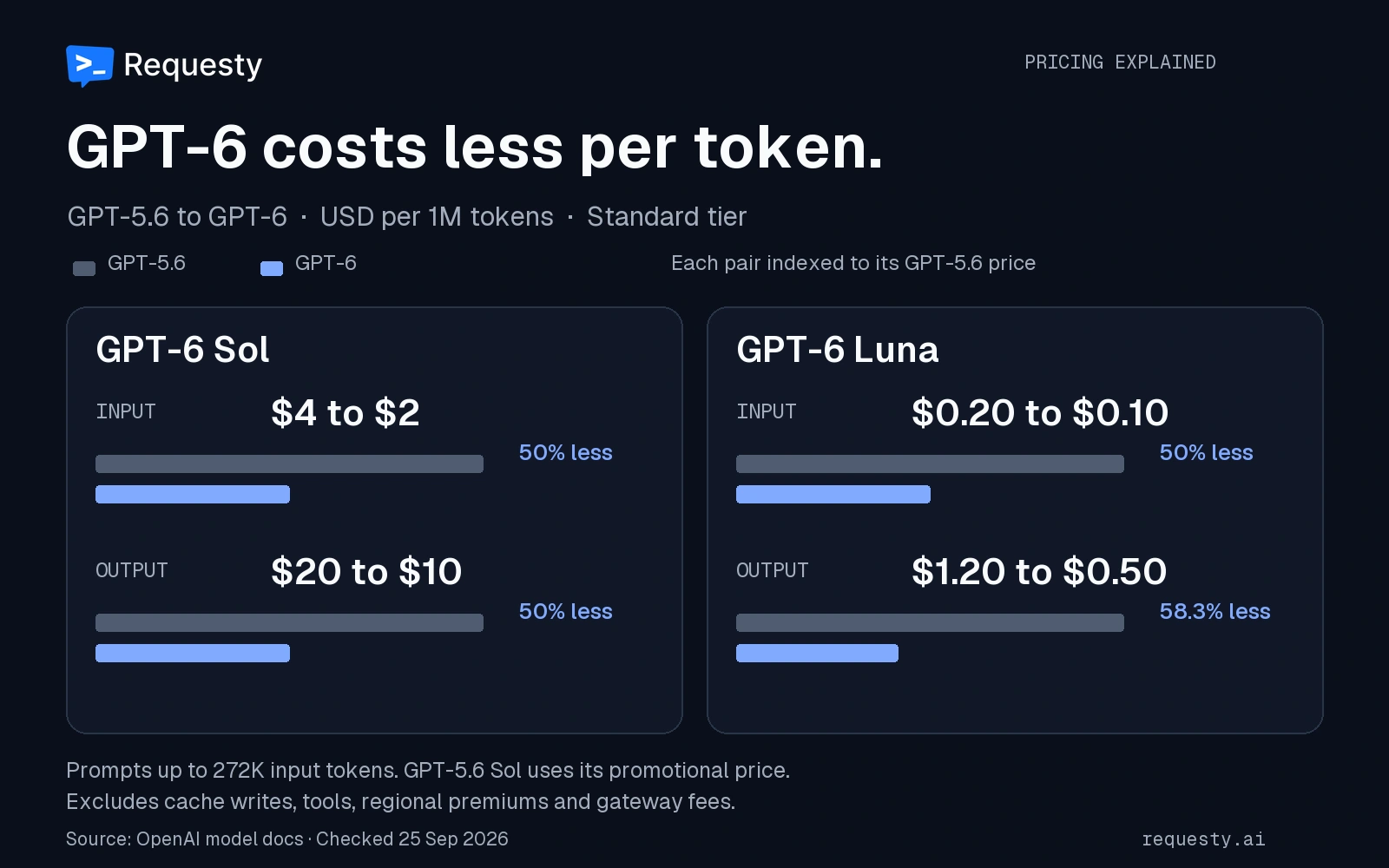
For a fair comparison, keep the processing tier and context length fixed. The table uses USD per million text tokens, Standard processing, and prompts with no more than 272,000 input tokens. Prices come from OpenAI's GPT-6 Sol, GPT-6 Luna, GPT-5.6 Sol and GPT-5.6 Luna listings. The GPT-5.6 Sol baseline is its current promotional price.
| Model | Ordinary input | Cached input | Output |
|---|---|---|---|
| GPT-5.6 Sol | $4.00 | $0.40 | $20.00 |
| GPT-6 Sol | $2.00 | $0.20 | $10.00 |
| GPT-5.6 Luna | $0.20 | $0.02 | $1.20 |
| GPT-6 Luna | $0.10 | $0.01 | $0.50 |
Sol's input and output rates are 50% lower. Luna's input rate is 50% lower, while its output rate is approximately 58.3% lower. Moving from $1.20 to $0.50 saves $0.70, or 58.3% of the previous rate. These percentages are calculated from the listed prices.
What would that mean for a workload?
Take an illustrative monthly workload of 100 million ordinary input tokens and 20 million billable output tokens. Assume every request stays below the long-context threshold, with no cache reads or writes, tool charges, regional premiums or gateway fees. Output includes any billable reasoning tokens.
| Model transition | GPT-5.6 cost | GPT-6 cost | Calculated saving |
|---|---|---|---|
| Sol to Sol | $800 | $400 | $400, or 50% |
| Luna to Luna | $44 | $20 | $24, or 54.5% |
For Sol, the new cost is (100 × $2) + (20 × $10) = $400. For Luna, it is (100 × $0.10) + (20 × $0.50) = $20. These are calculations using the published rates linked above, not observed customer savings.
The assumption that matters most is equal token usage. If one model needs longer reasoning, more retries or a different prompt, the final saving changes. Compare cost per accepted result as well as cost per token.
Caching, long prompts and processing tiers
Cached input and cache writes are separate billing categories. At Standard rates, GPT-6 Sol cache writes cost $2.50 per million tokens and Luna cache writes cost $0.125. Reusing eligible cached tokens is cheaper, but writing them is not free.
Under OpenAI's current caching rules, a write costs 1.25 times the ordinary input rate and a read costs 0.1 times that rate. For an identical eligible prefix written once and reused once, that totals 1.35 times its ordinary input cost, versus twice that cost without caching. This is a prefix-only calculation, not a 90% discount on the entire request.
Other conditions in OpenAI's pricing and Flex processing guide also matter:
- Long prompts: Above 272K input tokens, the whole request uses 2× input and cache rates and 1.5× output rates.
- Batch and Flex: Both are listed at 50% of Standard token rates. Flex can have slower responses and temporary capacity unavailability.
- Fast mode: Costs 2× the applicable rates.
- Regional processing: OpenAI lists a 10% premium where available. For Sol and Luna, EU data residency is supported only with Standard processing.
Those are OpenAI's processing terms. A gateway's endpoint, provider and region can have different listed rates, so check the route you select.
How to access GPT-6 Sol and Luna through Requesty
Both models are available on Requesty. The GPT-6 Sol model page and GPT-6 Luna model page list the available endpoints and provider prices.
Use the managed IDs gpt-6-sol and gpt-6-luna for Requesty's provider routing. For a pinned OpenAI deployment, use openai/gpt-6-sol or openai/gpt-6-luna. A pinned endpoint is not the same as a managed route with provider failover.
Here is a minimal text-generation example using the OpenAI Python SDK. Follow the Requesty quickstart to install the SDK and set REQUESTY_API_KEY in your environment before running it.
import os
from openai import OpenAI

client = OpenAI(
    api_key=os.environ["REQUESTY_API_KEY"],
    base_url="https://router.requesty.ai/v1",
)

response = client.chat.completions.create(
    model="openai/gpt-6-luna",
    reasoning_effort="medium",
    messages=[
        {
            "role": "user",
            "content": "Explain the risks of retrying a payment API request.",
        }
    ],
)

print(response.choices[0].message.content)
Change the model to openai/gpt-6-sol to compare the pinned Sol endpoint. This example does not call tools. OpenAI documents function calling through Chat Completions only when reasoning_effort="none" for these models; reasoning with tools requires Responses. Verify support for advanced Responses features on your chosen gateway route before adopting them.
Requesty's headline “from” prices include Flex endpoints: $1 input / $5 output for Sol, and $0.05 / $0.25 for Luna, per million tokens. These are not Standard-tier prices. The endpoint IDs are openai/gpt-6-sol:flex and openai/gpt-6-luna:flex.
The catalog displays upstream provider rates. Requesty's pricing page lists a 5% pay-as-you-go markup; its model pages state 0% markup when using your own provider keys. For example, the pinned Standard OpenAI rates become $2.10 / $10.50 for Sol and $0.105 / $0.525 for Luna with the 5% markup, before other applicable charges.
Are they available in ChatGPT and Codex?
At launch, both models became available in ChatGPT Work and Codex for Plus, Pro, Business, Enterprise and Edu users. Free and Go users received access to Luna in the desktop app. OpenAI's availability announcement distinguishes these surfaces from Chat, where the models were not yet available at launch.
For an application integration, use the API availability and pricing discussed here rather than assuming a ChatGPT subscription covers API usage.
What people are building with GPT-6 Sol and Luna
These creator posts show game development, design and agent experiments with the new models. Results and cost figures in the posts are the creators' own, not Requesty benchmarks. Several compare Sol or Luna with other models; the videos do not establish a general winner.

Claude Opus 5.5 vs GPT-6 Sol for 3D game development with Higgsfield in Unreal Engine.
Higgsfield compares GPT-6 Sol with Claude Opus 5.5 on 3D game development in Unreal Engine.

I said I’d keep benchmarking the rocket launch with GPT-6 Sol and GPT-6 Luna, so here are all four! 🚀 I gave each model the exact same prompt: “Build a rocket launch.” • Claude Opus 5.5 • GPT-6 Astra • GPT-6 Sol • GPT-6 Luna I’m starting to use this approach in my own Show more
Tony gives Sol, Luna, Astra and Claude Opus 5.5 the same rocket-launch build prompt.

Side-by-side: GPT-6 Sol vs Claude Opus 5.5. Both generated using Seedance2.5 on Medeo. Noticeable difference in scene comprehension and details—which one do you prefer?
Medeo compares Sol and Claude Opus 5.5 in scenes rendered with Seedance 2.5 on its platform.
Let's keep benchmarking with the Night train this time, with GPT-6 Sol and GPT-6 Luna, so here are all four! 🚀 I gave each model the exact same prompt: “Build a Night train.” •Opus 5.5 • GPT-6 Astra • GPT-6 Sol • GPT-6 Luna Something that really surprised me: GPT-6 Show more
Tony repeats his four-model comparison with a night-train build prompt.

We gave 4 models the same prompt: build a lava lamp. Claude Opus 5.5: $1.27, 9m 35s GPT-6 Astra: $0.63, 5m 4s GPT-6 Sol: $0.08, 50s GPT-6 Luna: <$0.01, 43s Which one did the best?
Bridgebench shares four models' results for the same lava-lamp prompt, including Sol and Luna.

🚨 GPT-6 Luna Max is seriously underrated, I used it on my chip benchmark and it actually searched for and created the images itself to make everything look as realistic as possible, from the colors to the smallest details, It also launched sub agents to judge the result and Show more
SPAC89 shows a chip-design benchmark using Luna Max, with image search and subagents.

And now... GPT6 Sol and GPT6 Luna, side-by-side. Exact same prompt, same conditions (no harness). Clearly (far) beneath Opus 5.5 BUT Consider the price! Sol6 : $0.70 Luna6: $0.04 Full spike here: ohmyunicorn.com/labs/dream-loo…
Timothée Le Borgne compares Sol and Luna on the same prompt and shares the cost of each run.

We benchmarked GPT-6 models in DOOM by having LLM agents fight each other. Across 120 matches, we found: - Astra had the highest win rate at 82.5% - Sol made the fastest decisions at avg of 5.34s - Luna had the most wins per dollar at 12.8 GitHub: github.com/Rootly-AI-Labs… Show more
Hamza shares a 120-match DOOM agent experiment comparing Astra, Sol and Luna.
Should you move from GPT-5.6 to GPT-6?
Start with work you already understand. Run a representative set of requests through the old and new models, keep reasoning effort and service tier comparable, and record task success, latency, token usage and the human work left afterwards.
Luna is a candidate to evaluate for structured extraction, classification, drafting and well-defined implementation work. Sol is worth testing where ambiguous requirements, complex code or costly mistakes justify spending more on the first attempt. These are evaluation starting points based on OpenAI's documented positioning, not claims that one model will always win a particular task.
The opportunity is to reconsider which parts of the workflow need the more expensive model at all, without lowering the standard for the finished result.
You can start that comparison with GPT-6 Luna on Requesty and GPT-6 Sol on Requesty.
Sources
Prices and specifications checked September 25, 2026. Calculations and illustrative assumptions are identified in the text.
- OpenAI API changelog: September 22 release
- OpenAI model catalog
- OpenAI: GPT-6 Sol documentation
- OpenAI: GPT-6 Luna documentation
- OpenAI: GPT-5.6 Sol documentation
- OpenAI: GPT-5.6 Luna documentation
- OpenAI: Introducing GPT-6 Sol and Luna
- OpenAI: GPT-6 model guidance
- OpenAI: Better prompt caching for GPT-6
- OpenAI: Prompt caching guide
- OpenAI API pricing
- OpenAI: Flex processing
- Requesty: GPT-6 Sol model and provider comparison
- Requesty: GPT-6 Luna model and provider comparison
- Requesty: Pinned OpenAI GPT-6 Sol endpoint
- Requesty: Pinned OpenAI GPT-6 Luna endpoint
- Requesty quickstart
- Requesty: GPT-6 Sol Flex
- Requesty: GPT-6 Luna Flex
- Requesty pricing
- OpenAI launch availability announcement
Frequently asked questions
- When were GPT-6 Sol and GPT-6 Luna released?
- OpenAI released both models on September 22, 2026.
- How much does GPT-6 Luna cost?
- Standard API pricing for prompts up to 272K input tokens is $0.10 per million ordinary input tokens, $0.01 for cached input and $0.50 for output. Cache writes cost $0.125 per million tokens.
- How much does GPT-6 Sol cost?
- Standard API pricing for prompts up to 272K input tokens is $2 per million ordinary input tokens, $0.20 for cached input and $10 for output. Cache writes cost $2.50 per million tokens.
- Is GPT-6 Luna cheaper than GPT-5.6 Luna?
- At the listed Standard rates, ordinary input is 50% cheaper and output is about 58.3% cheaper. The total saving depends on token usage, caching and processing tier.
- Can I use GPT-6 Sol and Luna on Requesty?
- Yes. Both have managed model IDs and pinned provider endpoints on Requesty. Check the endpoint's processing tier and the applicable Requesty fees when comparing prices.
- SEP '26
Claude Opus 5.5 explained: pricing, API access and what changed
Claude Opus 5.5 lowers input and output prices by 20% and cache-read prices by 60%. Here is what changed, how adaptive thinking works and what to check before migrating.
- SEP '26
Jev, week two: 1,316 posts, four gateways giving it away, and an open weight clone trained on one GPU
TypeSafe's decision model launched on 15 September. By 22 September our tracker had 1,316 posts from 965 authors, the daily count had plateaued near 280, Vercel and Lovable had both made it free for a week, OpenRouter had benchmarked it at five times the speed of the next fastest judge, and r/LocalLLaMA had shipped three open weight imitations. Here is what builders did with a model that refuses to chat, what they complained about, and how to evaluate one for your own pipeline.
- SEP '26
TypeSafe Jev explained: how it works, LLM differences and API pricing
A practical guide to TypeSafe's decision model, what its probabilities mean, and how to access Jev through Requesty.