
There is a popular idea that AI never sleeps: an always-on tide of autonomous agents grinding through work around the clock. The traffic on our gateway tells a more human story. AI has a schedule, and it looks a lot like ours.
The machines mostly work when we do
Start with the week. If agents ran the show, traffic would be flat across seven days. It is not.
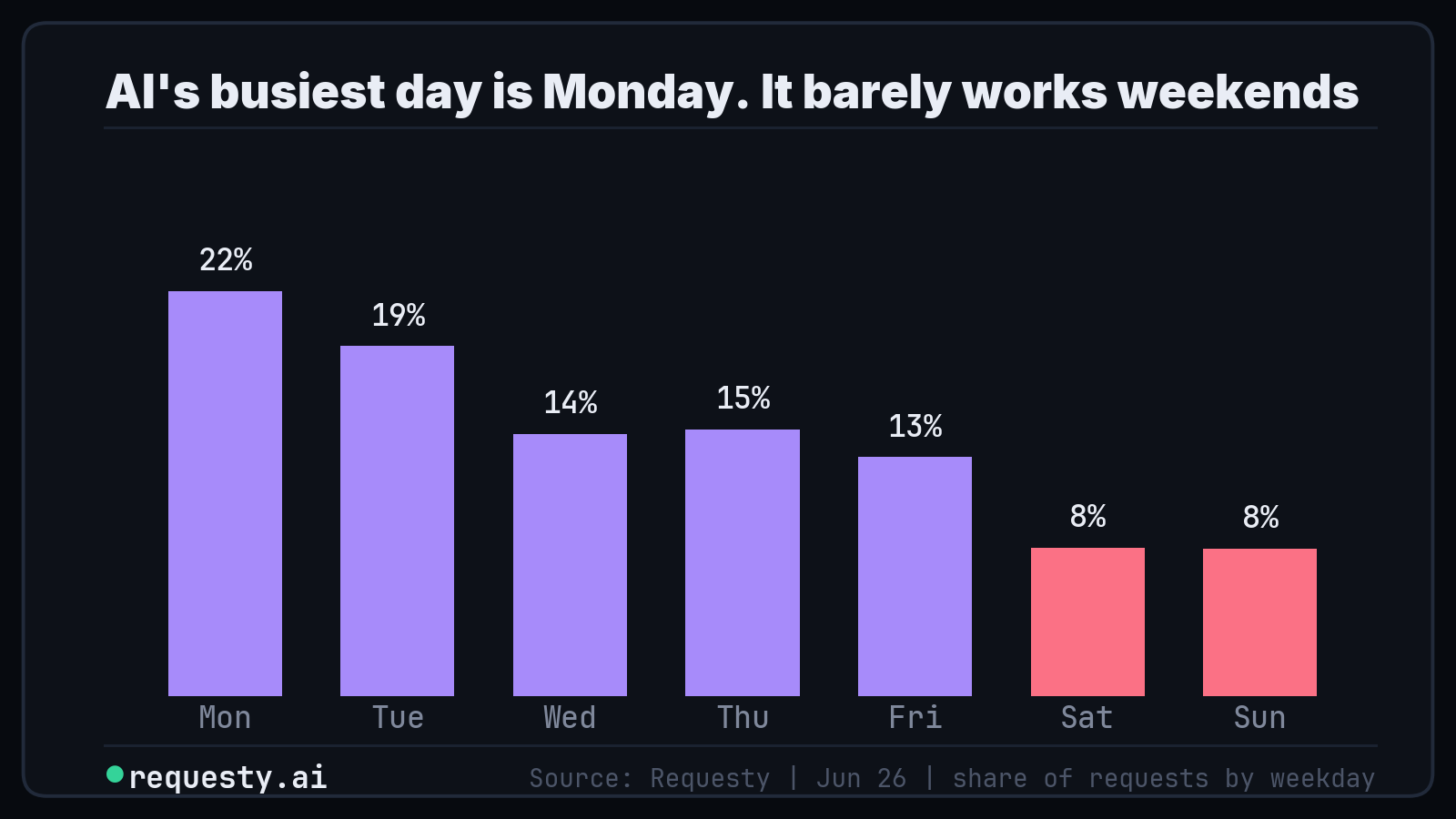
Monday is the busiest day. The week tapers from there, and the weekend falls off a cliff. Saturday and Sunday each run at roughly a third of a weekday. Whatever is driving demand, it clocks in on Monday and clocks off on Friday, same as the people building with it.
The daily curve is a workday curve
Zoom into the hours and the same pattern repeats. Traffic ramps in the morning, peaks in the working day, and falls off overnight.
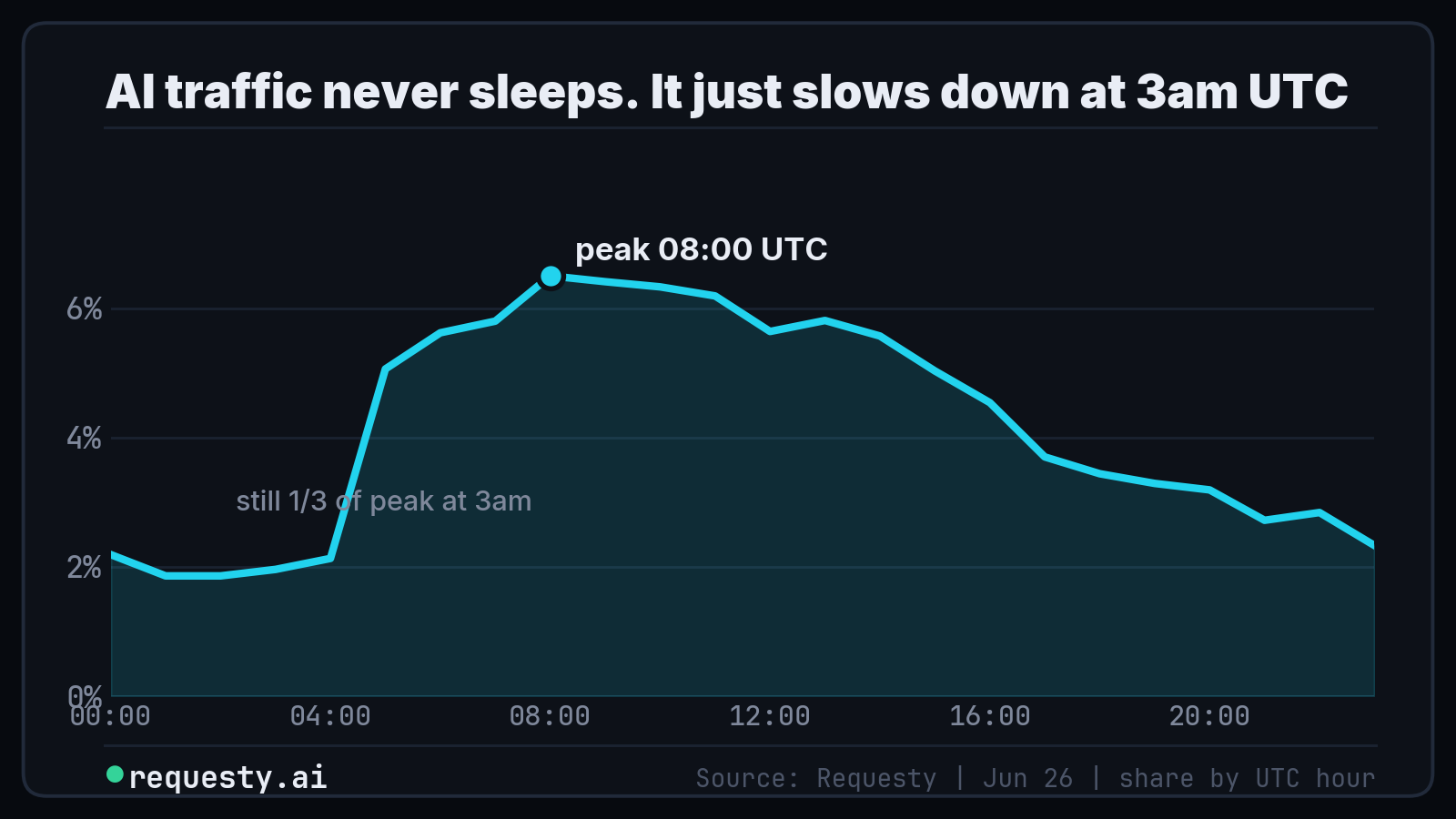
There is a twist worth noting. Even at the quietest hour, the gateway is running at about a third of peak. So it is not that AI sleeps. It is that the overnight floor is held up by genuine automation and by users spread across time zones, while the peak is still driven by people at work. The shape is a workday with a surprisingly high floor, not a machine that runs flat out at 3am.
Nobody streams as much as you think
Here is the one that gets the most disbelief. Every product demo you have seen streams tokens with that typewriter effect. In production, most requests do not.
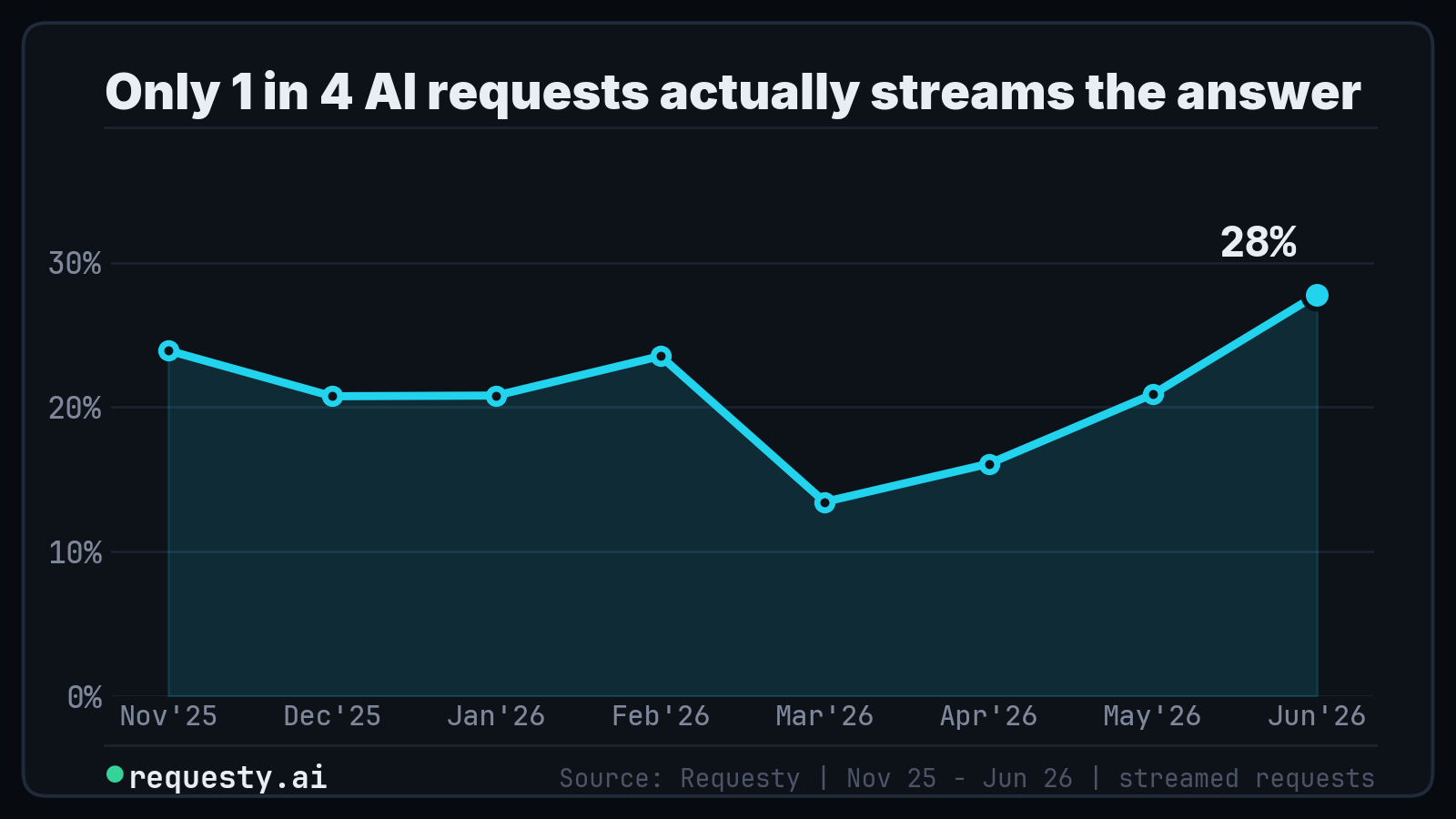
Only about 1 in 4 requests through the gateway streams the answer. The reason is the same agentic shift we keep coming back to. Agents do not need the typewriter effect. They want the tokens, parsed and structured, so they can act on them. A tool-calling loop has no human watching characters appear. Streaming is a UX feature for people, and a large and growing share of traffic has no person in the loop.
Why the rhythm matters operationally
This is not just trivia. The shape of your traffic should shape your infrastructure.
- Capacity and cost follow the curve. If your load triples from trough to peak and collapses on weekends, provisioning for peak 24/7 is waste. Watch the curve in usage analytics and plan around it.
- Latency routing pays off most at peak. When everyone hits the same providers on Monday morning, the fast route and the slow route diverge. Routing to whatever is fastest right now matters more under load. See latency routing.
- Streaming is a choice, not a default. If your workload is agentic, non-streaming with structured outputs is often the better call. If it is a chat UI, stream. Know which one you are. See the streaming docs.
We publish per-provider operational cuts, including streaming adoption and latency, on our open data hub at requesty.ai/data.
The machines mostly work when we do. Build for the peak you see on Monday, not for a mythical always-on flood, and stream only where a human is watching.
Want routing that adapts to load automatically? Start free or read the quickstart.
- MAY '26
What the gateway saw in April 2026: agents live on Anthropic, open-source models got fast, and the latency gap is 14×
A read of the per-provider operational data from Requesty's gateway in April 2026. Anthropic-direct serves twice as many tool calls as the next provider. Open-source aggregator routes are 9-14× faster than they were a year ago. p50 latency between fastest and slowest providers spans 15×.
- JUL '26
Why Traditional Latency Routing Fails and How We Fixed It With One Formula
Traditional latency routers pick the fastest provider. That provider fails up to 60% of requests at night. Here is how Thompson Sampling with a reliability penalty cuts errors by 75% and delivers 35% faster P50 latency, using one self calibrating formula.
- APR '26
Agentic routing, benchmarked: Requesty adds 16ms of overhead, OpenRouter adds 55ms
Agentic routing is the decision layer inside a multi-agent LLM system that picks which model or sub-agent handles an incoming request. Here's what it does, what it costs, and how the gateways compare.