
Most AI commentary is about demand: more tokens, more users, bigger workloads. The side nobody charts is supply. How many places can you buy inference from, how many models are on the menu, and how many different apps are calling them. All three are growing fast, and the fragmentation changes how you should build.
The number of providers doubled
Start with where inference comes from. A provider here is a distinct upstream we route to: a lab, a cloud, or an aggregator.
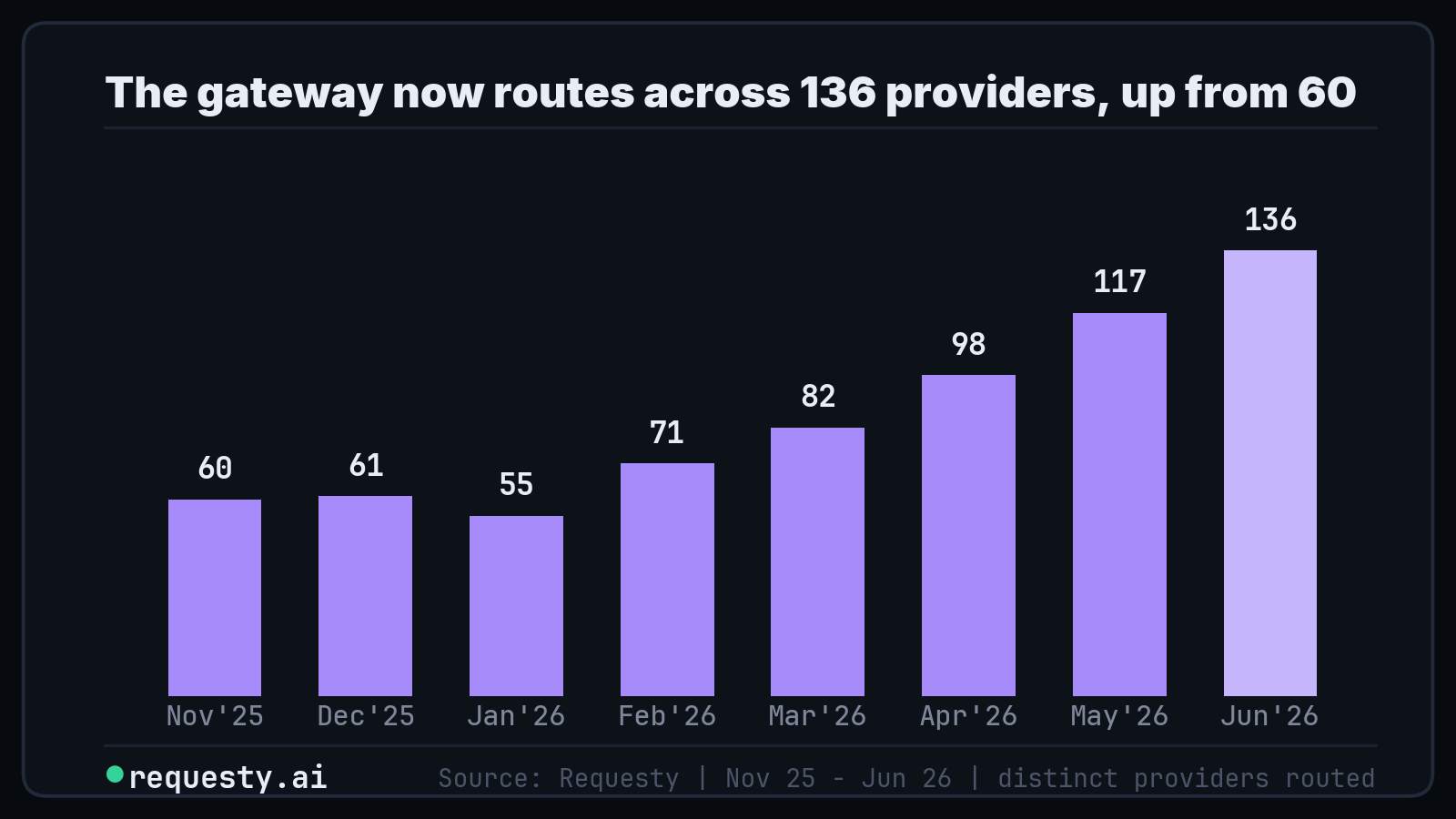
A year ago we routed across about 60 providers a month. In June it was 136. Every model now has several places it can be served from, each with its own price, latency, and reliability. The same Claude or Llama can sit behind half a dozen endpoints that look identical to your code and behave nothing alike in production.
The model menu keeps growing
More providers means more model variants. The count of distinct models teams route to climbs every month.
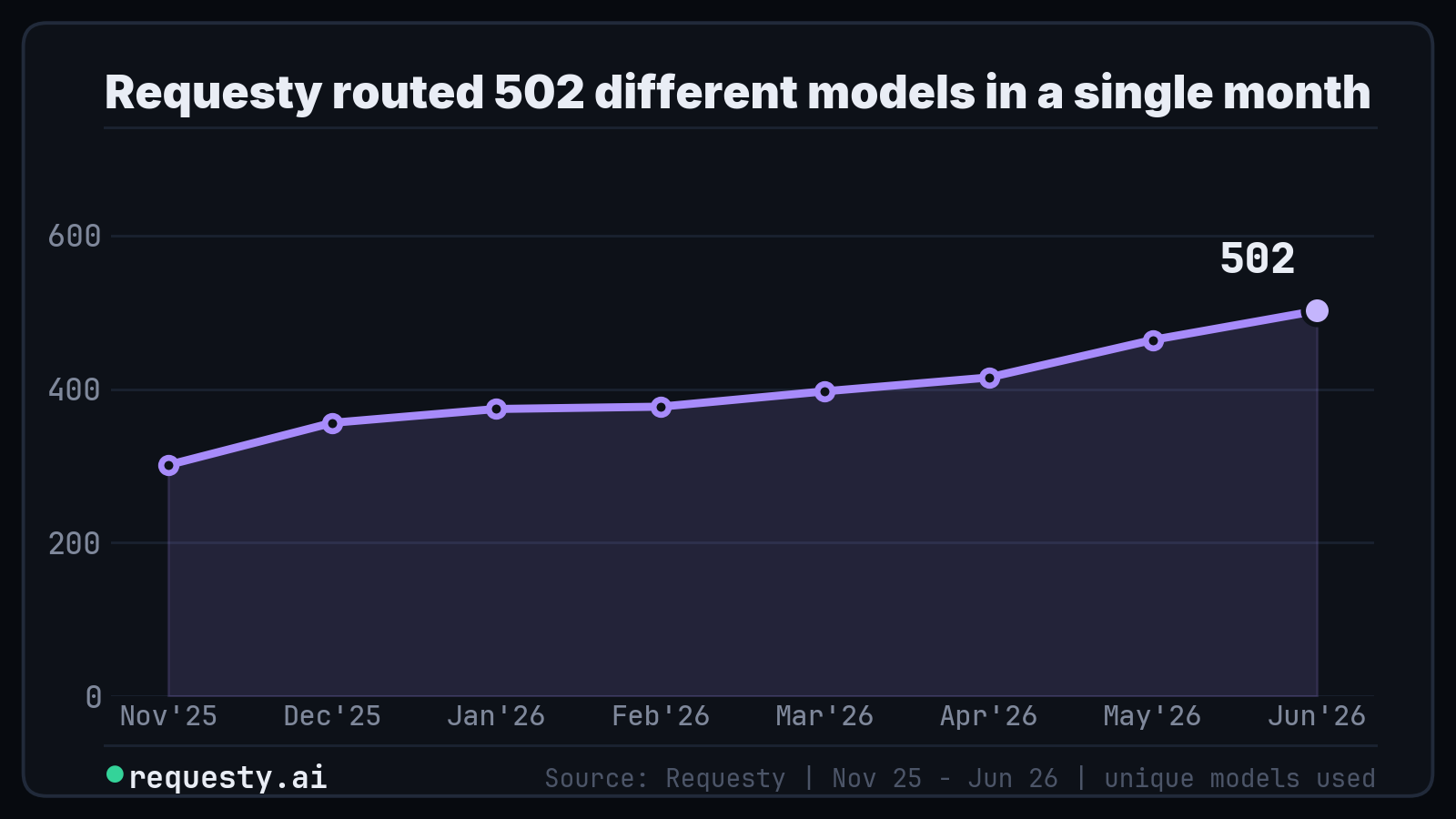
502 distinct models in June, up from around 300 a year earlier. This is the flip side of the churn we wrote about in no model stays number one. The menu grows faster than anyone can evaluate, so picking one model and freezing it gets more expensive by the month.
The client explosion is real
Now the demand-facing edge of the same trend: the number of distinct client apps hitting the gateway.
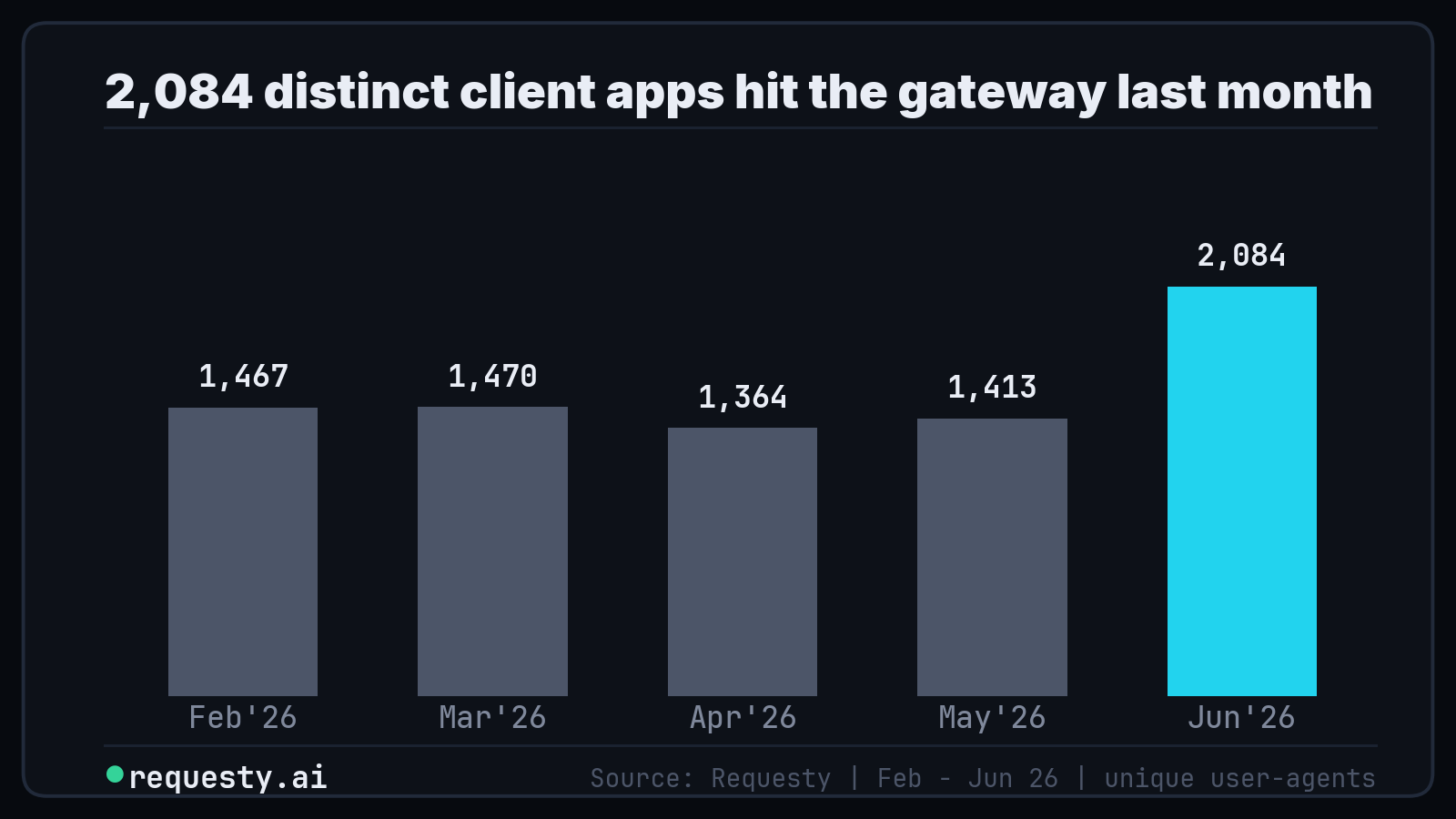
2,084 distinct client apps in June, up sharply in a single month. Coding agents, chat frontends, custom internal tools, SDKs pointed at our endpoint. The tooling layer is proliferating as fast as the model layer. Every one of those clients is a slightly different workload with slightly different needs.
Fragmentation quietly makes two things better
When supply fragments, two operational metrics improve, and both show up in the data.
First, caching. As workloads mature and prompts stabilize, more of the input is served from cache instead of recomputed.
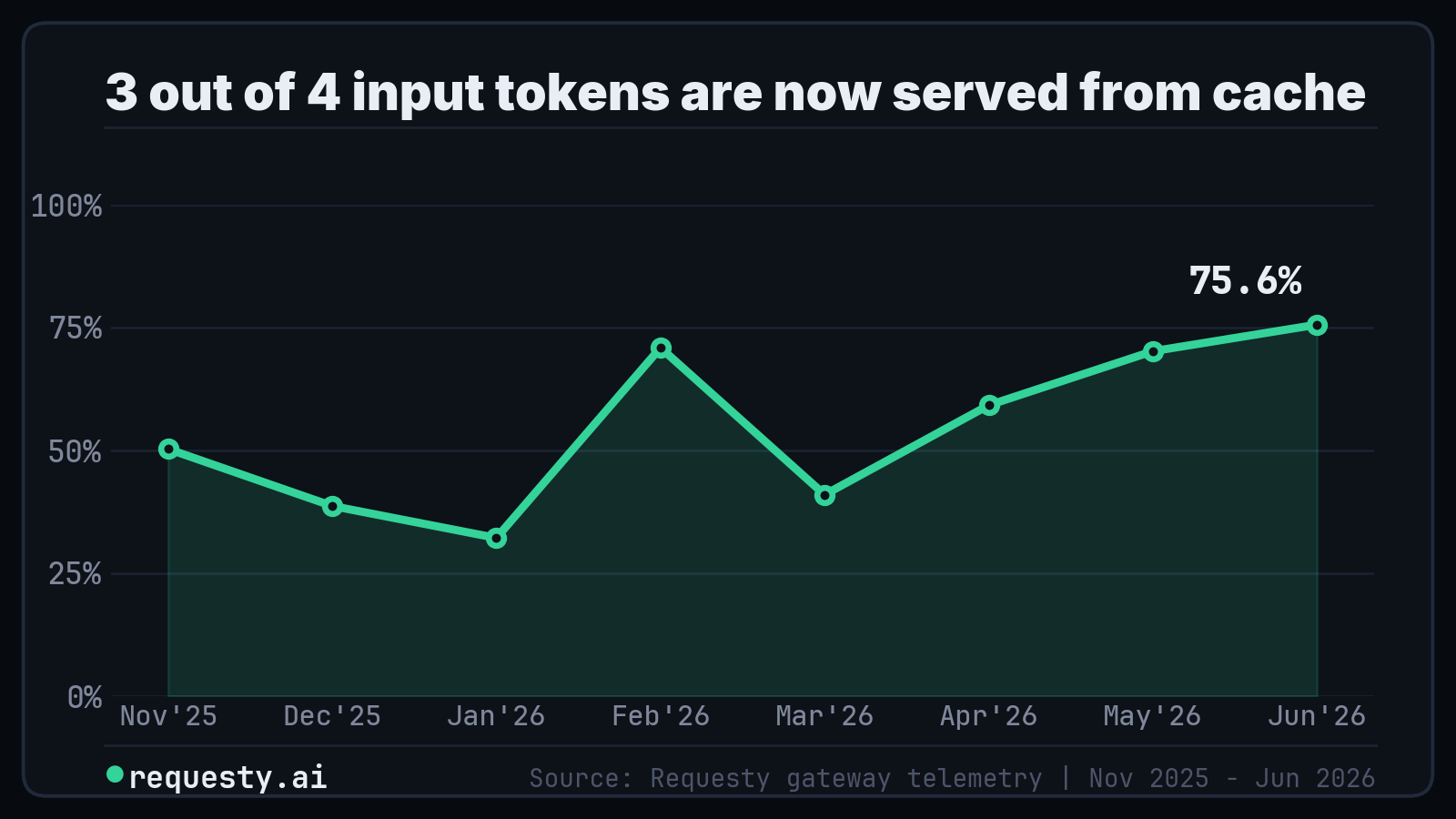
A large share of input tokens now comes from cache. That is the single biggest lever on cost for prompt-heavy workloads, and it gets better as your traffic settles into patterns. See auto-caching.
Second, reasoning. More of what models generate is now internal thinking rather than visible output.
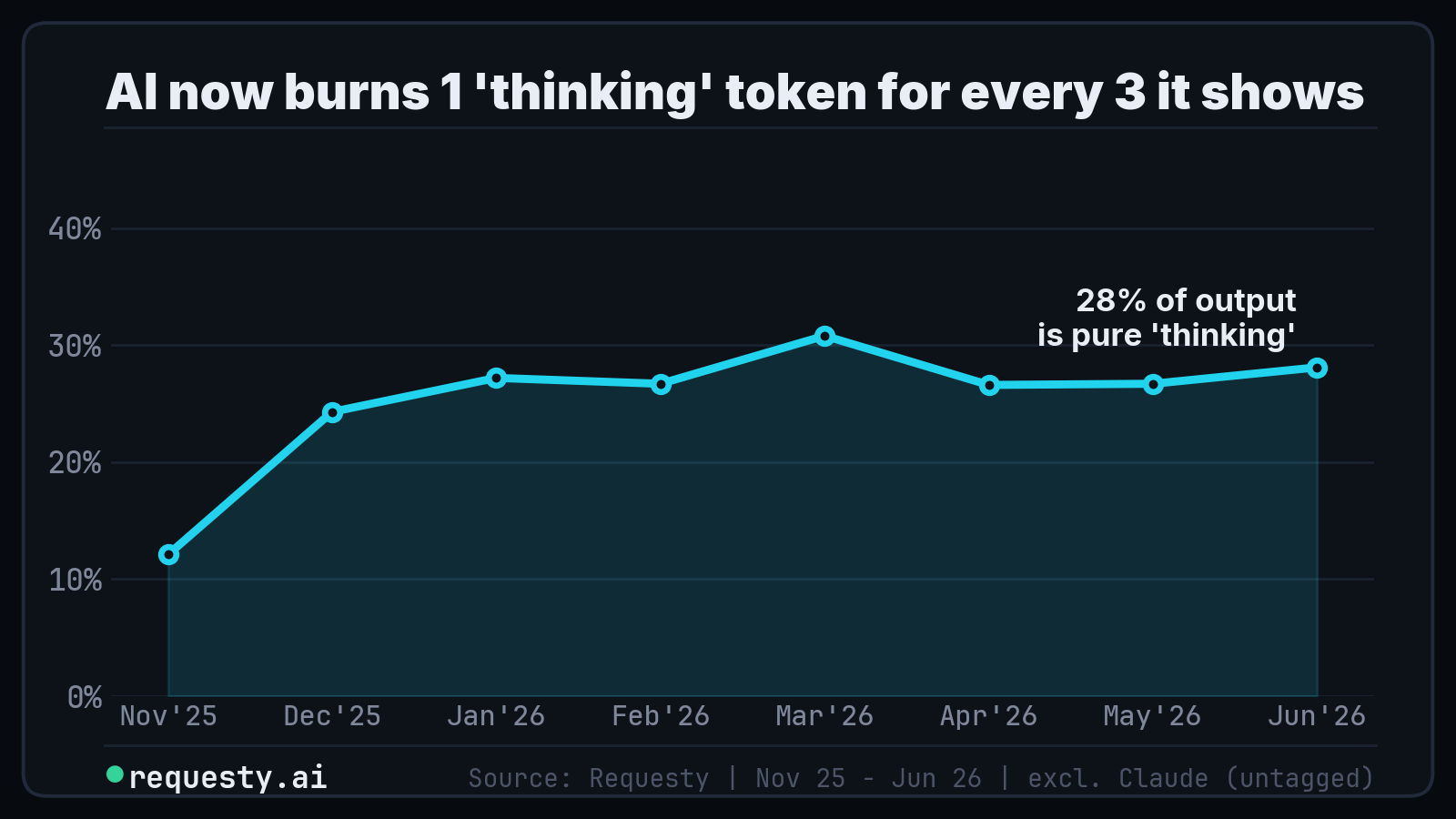
A growing slice of every response is the model reasoning to itself before it answers. You pay for it and you never see it. As reasoning models spread across the expanding provider set, this share keeps climbing. See the reasoning docs.
What to do when supply fragments
A fragmented supply side is good for you if you can exploit it and painful if you cannot. The teams that come out ahead do a few things:
- They treat provider choice as a runtime decision, not a code constant. Load balance across equivalent routes and fail over when one degrades. See load balancing and fallback policies.
- They route to the fastest healthy endpoint per request instead of pinning one. See latency routing.
- They turn on caching early so the maturing workload compounds into cost savings. See auto-caching.
We publish the per-provider operational cuts behind these charts on our open data hub at requesty.ai/data.
The supply side of AI is fragmenting as fast as demand is growing. One endpoint is a liability. A gateway that turns 136 providers into one stable interface is how you turn that fragmentation from a tax into an advantage.
Route across every provider and model through one API. Start free or read the quickstart.
- JUL '26
No model stays #1: the leader's share of gateway traffic fell from 29% to 8% in eight months
The model wars do not have a winner. They have churn. The single most used model held 29% of traffic last November. By June the leader held just 8%, and the crown changed hands almost every month.
- JUN '26
Best LLM Routing Platforms Compared (2026): Requesty, Portkey, LiteLLM, OpenRouter, and More
Seven LLM routing platforms compete for production AI traffic in 2026. This guide compares Requesty, Portkey, LiteLLM, OpenRouter, Kong AI Gateway, Cloudflare AI Gateway, and Helicone on latency, cost, routing intelligence, caching, compliance, and self-hosting options with real benchmark data.
- MAY '26
What the gateway saw in April 2026: agents live on Anthropic, open-source models got fast, and the latency gap is 14×
A read of the per-provider operational data from Requesty's gateway in April 2026. Anthropic-direct serves twice as many tool calls as the next provider. Open-source aggregator routes are 9-14× faster than they were a year ago. p50 latency between fastest and slowest providers spans 15×.