
Every few weeks someone tells me the model wars are over and one lab has won. From where I sit, routing traffic for hundreds of models, the data says the opposite. There is no durable number one. There is churn, and it is getting faster.
The leader keeps losing its grip
Here is the clearest way to see it. Take the single most used model each month and plot its share of all traffic on the gateway.
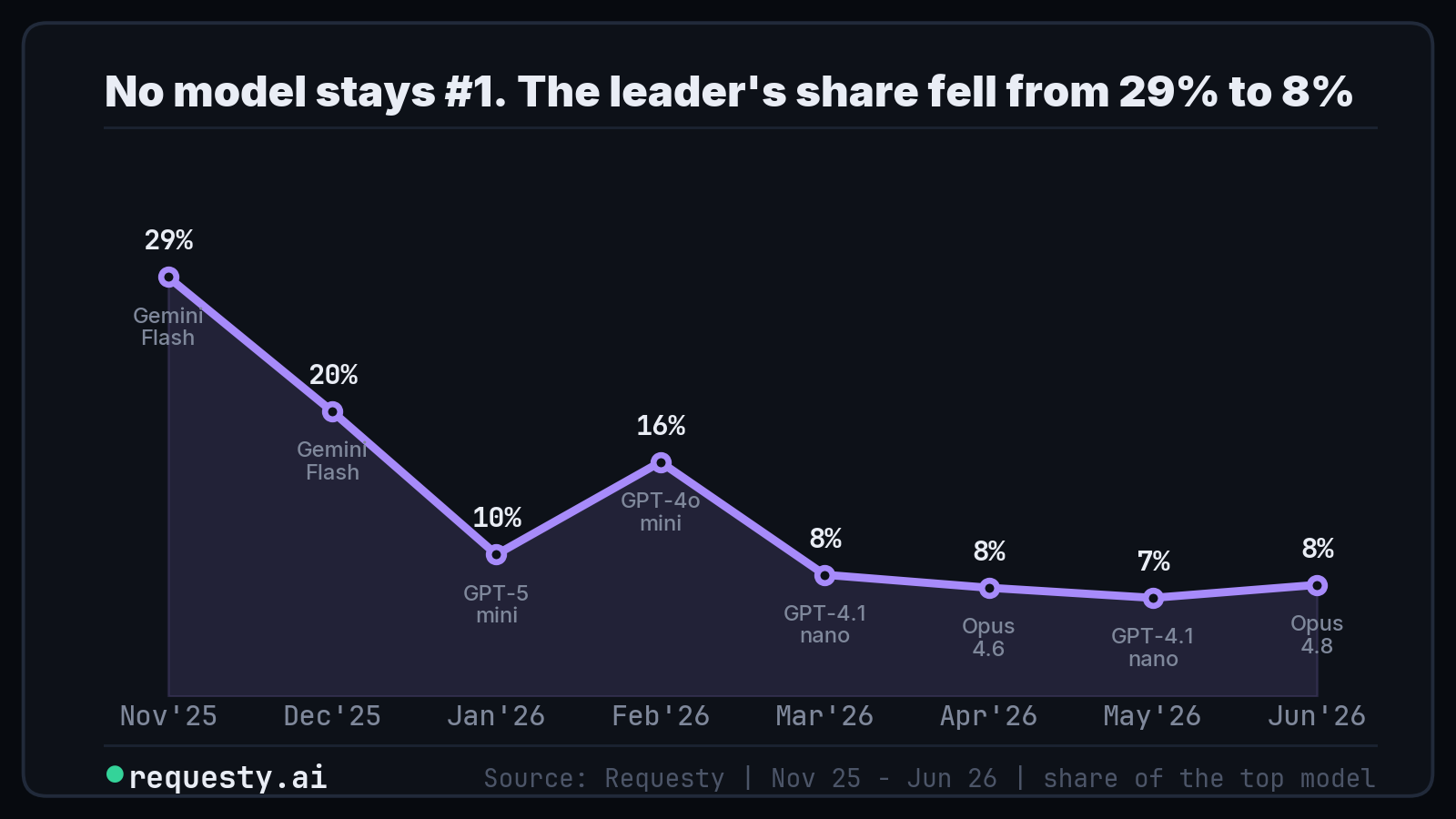
Last November, the top model held 29% of everything flowing through us. By June, the leader held 8%. And it was not the same model holding on and slipping. The crown changed hands almost every month: Gemini Flash, then a GPT mini, then a GPT nano, then Claude Opus. The concentration is falling and the turnover is high.
One detail worth sitting with: the most used models are rarely the flagships. They are the cheap, fast, small models. The headlines go to the frontier releases. The traffic goes to whatever is good enough and inexpensive for the job.
The menu keeps getting longer
Fragmentation at the top is downstream of a simpler force. The number of distinct models teams route to keeps climbing.
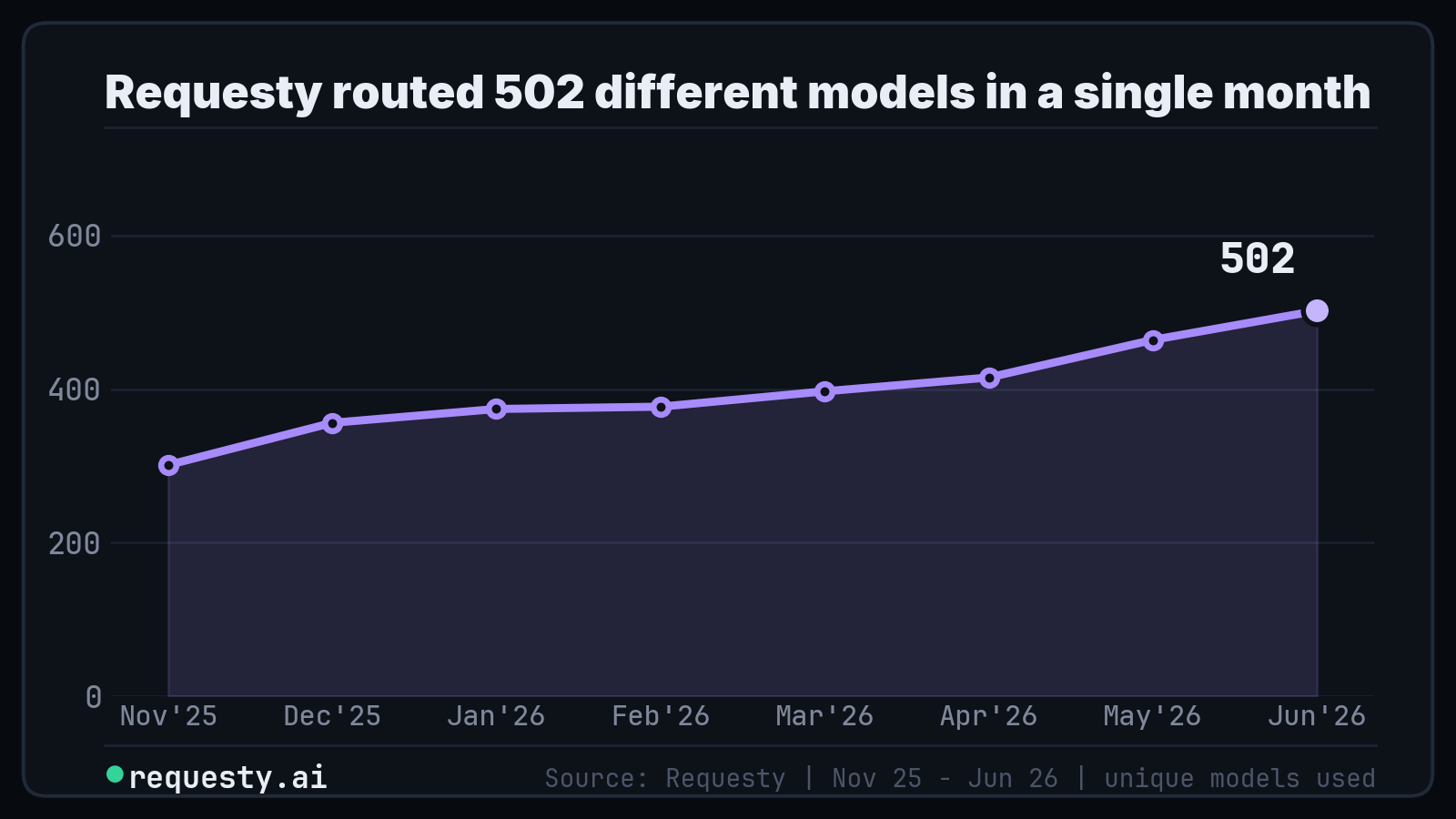
A year ago teams touched about 300 models a month through us. In June it was 502. The "which model should I use" problem is not getting easier. It is getting harder, because the menu keeps expanding faster than anyone can evaluate it.
Open weights are a real part of the mix now
Part of what is eroding the incumbents is the rise of open-weight models. DeepSeek is the sharpest example.
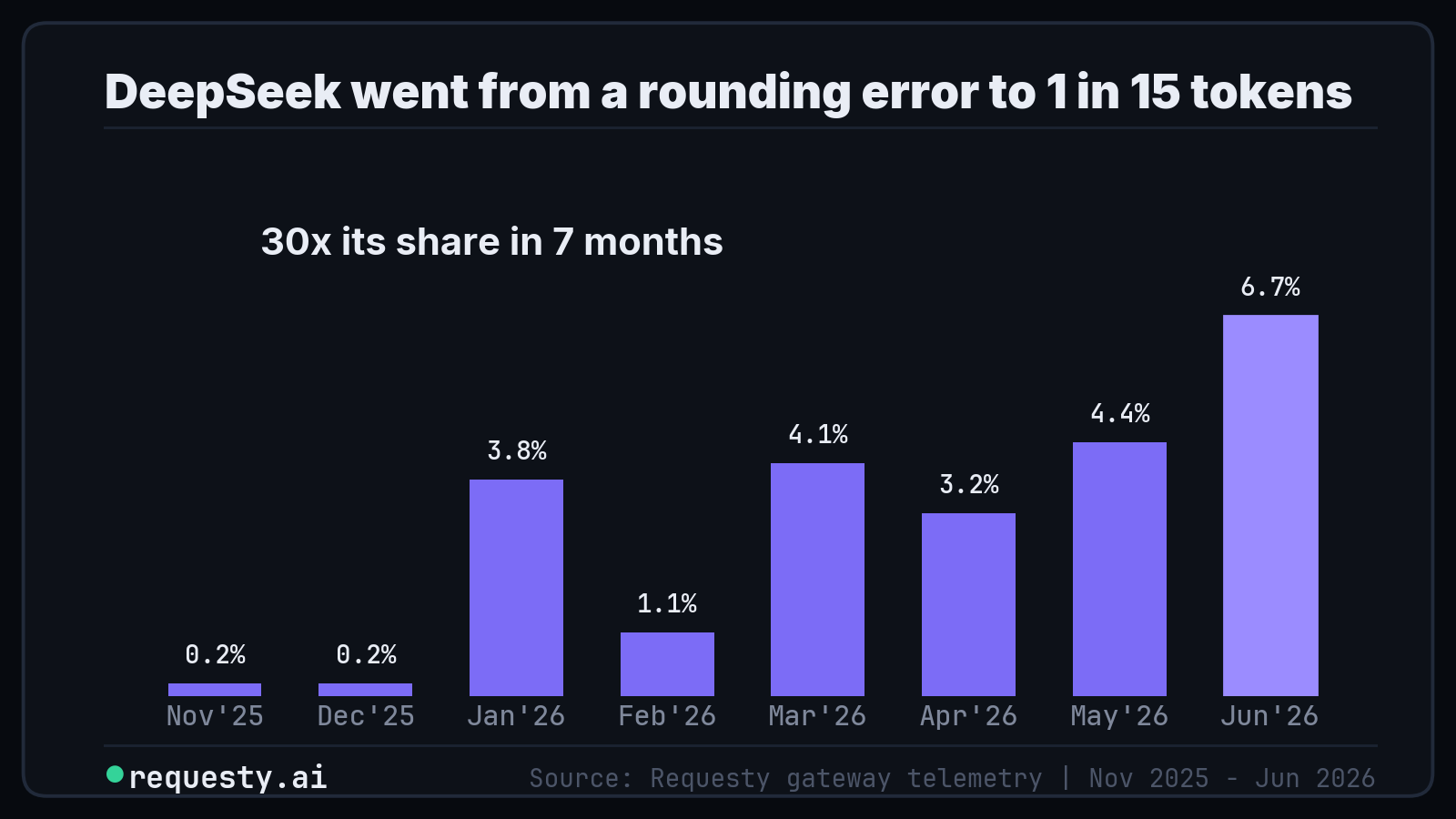
DeepSeek went from a rounding error to a serious slice of traffic in a matter of months. Every time an open-weight model gets close enough on quality and undercuts on price, a chunk of traffic moves. That is a big reason no single proprietary model can hold a dominant share for long.
Loyalty is measured in days
The last piece is speed of adoption. When a strong new model lands, teams do not wait.
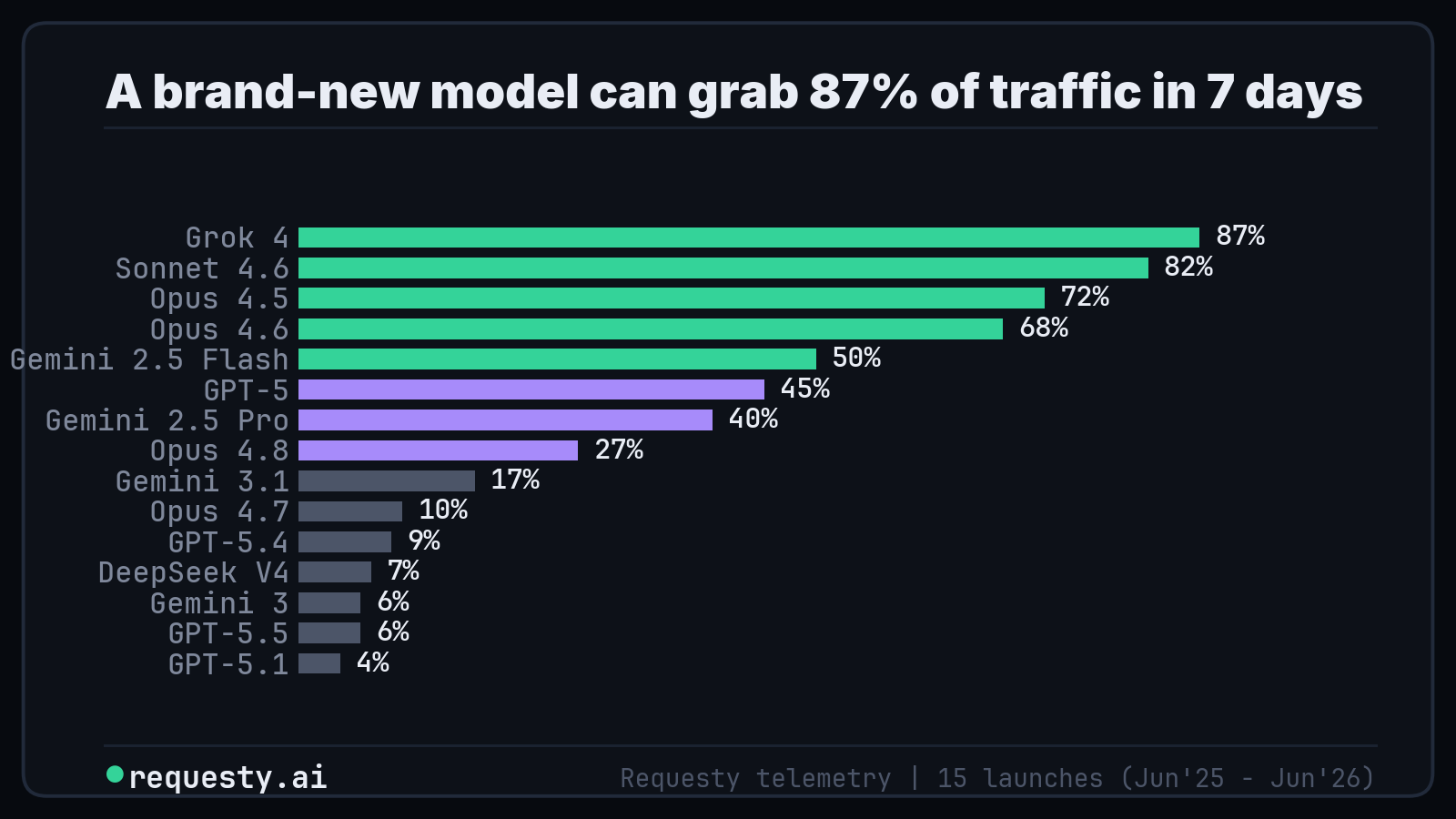
A generational model can grab most of its family's traffic within a week of launch. Incremental point releases barely move. The market is not sticky at the top. It is quick to reward a genuine step change and quick to ignore a minor one.
What this means if you are building
If no model stays on top, then hard-coding one model into your product is a standing liability. The teams that handle this well share a pattern:
- They route by policy, not by a hard-coded model name, so switching leaders is a config change, not a redeploy. See smart routing and the supported models catalog.
- They keep a fallback chain so a model going down or getting deprecated does not take the product with it. See fallback policies.
- They test new models on a slice of live traffic instead of betting the app on a benchmark. Adoption speed only helps you if you can move fast safely.
We publish the underlying model and provider cuts on our open data hub at requesty.ai/data, including the OSS family share trend and per-provider operational metrics.
The takeaway I would bet on: the model layer is a commodity in motion. Build so you can swap the leader every month, because the data says you will have to.
Route across every major model without rewrites. Start free or read the quickstart.
- JUN '26
Best AI Coding Model (2026): Benchmarks, Cost, and Real World Performance
Claude Fable 5, GPT-5.5, Claude Opus 4.8, Gemini 3.5 Flash, DeepSeek V4, and Kimi K2.7 Code all claim top coding performance in 2026. This guide compares them on SWE-bench, Terminal-Bench, FrontierCode, cost per million tokens, and real-world agentic coding tasks so you can pick the right model for your workload.
- APR '26
Agentic routing, benchmarked: Requesty adds 16ms of overhead, OpenRouter adds 55ms
Agentic routing is the decision layer inside a multi-agent LLM system that picks which model or sub-agent handles an incoming request. Here's what it does, what it costs, and how the gateways compare.
- MAY '26
What the gateway saw in April 2026: agents live on Anthropic, open-source models got fast, and the latency gap is 14×
A read of the per-provider operational data from Requesty's gateway in April 2026. Anthropic-direct serves twice as many tool calls as the next provider. Open-source aggregator routes are 9-14× faster than they were a year ago. p50 latency between fastest and slowest providers spans 15×.