
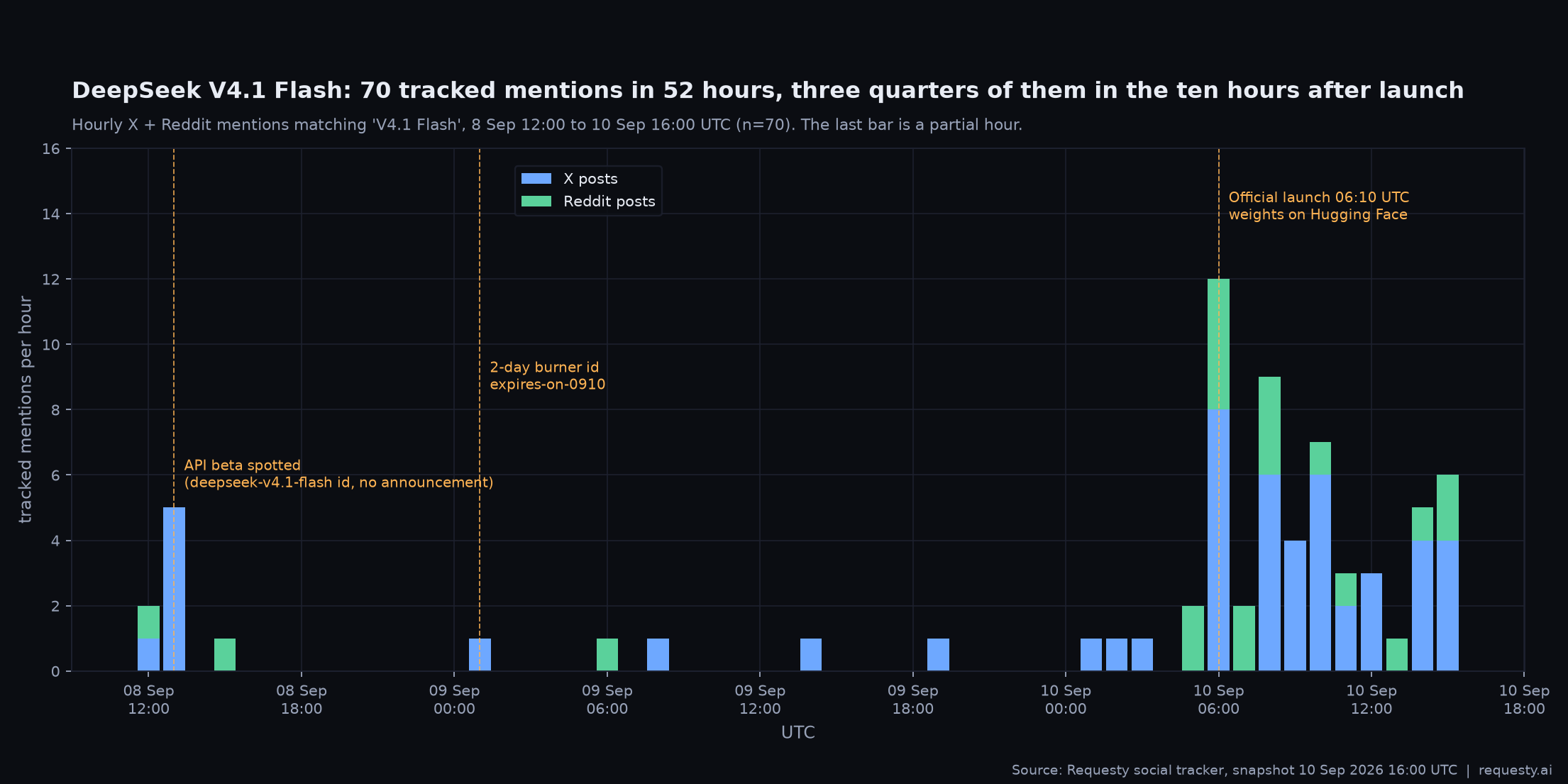
At 06:10 UTC on 10 September, DeepSeek posted a six tweet thread introducing DeepSeek-V4.1-Flash. By the time we took our snapshot ten hours later it had 21,110 likes, 3,311 bookmarks and 2.78 million impressions. Our tracker logged 70 X and Reddit posts naming the model across 52 hours, three quarters of them in the ten hours after that tweet.
The launch is a good model release. It is also, buried in the official release note, one of the more aggressive lifecycle decisions a lab has published this year, and that second part is what a production team needs to act on this week.
What shipped
DeepSeek's own description, from the release note and the pricing page:
- 552B parameter mixture of experts, described as the smallest model in a new architecture family, with weights on Hugging Face under MIT.
- A causal encoder decoder design that activates 8B parameters on the input side and 16B on the output side. Asymmetric compute is the headline architectural change.
- A much smaller KV cache: a quarter of the HBM and an eighth of the SSD storage of the previous generation, which DeepSeek ties directly to agent economics: "cache hit charges often account for a large share of agent costs."
- Native image understanding and a 1M token context, with a 384K maximum output.
- New pre-training methods plus larger scale RL post-training, which DeepSeek says put it ahead of V4 Pro on their benchmarks.
r/LocalLLaMA spent the morning arguing about the parameter count: one poster read the safetensors and found roughly 552B in the main model plus about 197B of optional engram parameters and 14B of speculative decoding weights, for a total nearer 748B on disk. If you plan to self host, budget for the larger number.
The reaction that carried the day came from @thdxr, 169,000 followers, 2,410 likes: a minor update to a flash model is surpassing the previous pro model. @kimmonismus put it in six week context: July's V4 Flash update changed post-training only, this one changes the architecture. And Cline's team posted the price comparison that will be copied into a hundred decks: at $0.30 and $1.20 per million tokens, roughly a twentieth of Opus 5, a seventeenth of GPT-5.6 Sol and a twelfth of Kimi K3, while beating all three on Terminal-Bench in their test.
We have not verified those benchmark claims. Artificial Analysis had not published an independent V4.1 Flash score as of our snapshot at 16:00 UTC on 10 September, and DeepSeek's own table is a vendor table. The dated evidence we can cite is the prior generation: in the same snapshot, DeepSeek V4 Pro 0813 scores 36.3 on the Intelligence Index at a blended $1.98 per million tokens, while GLM-5.3 Flash scores 41.9 at $0.24. That is the neighbourhood V4.1 Flash is entering, and it explains why the community treated "beats Pro" as plausible rather than surprising.
The part that changes your production config
Here is the sentence from the release note that matters more than any benchmark:
Starting at 04:00 UTC on Sept 14, 2026, all deepseek-v4-pro requests will route to V4.1-Flash at V4.1-Flash rates. This will continue until V4.1-Pro launches.
And from the pricing page footnotes:
Use deepseek-flash as the model name. The legacy names deepseek-v4-flash and deepseek-v4-flash-vision-exp are still accepted, but the corresponding models have been retired, their requests are served by the DeepSeek-V4.1-Flash model and billed at the Flash price.
Read those together. Three model ids that teams pinned in April, July and August (deepseek-v4-pro, deepseek-v4-flash, deepseek-v4-flash-vision-exp) now return, or will return in four days, a model that none of them were evaluated against. Two of them already do. The Pro redirect lands on a Monday morning with four days of notice, and the release note frames it as good news: you get a better model for less money.
For most workloads that framing will hold. DeepSeek says multiple parties tested V4.1 Flash ahead of V4 Pro on performance, cost, speed and total runtime, and the price drop is real: a Pro request at peak costs $1.32 in and $3.96 out today and $0.30 and $1.20 on Monday. But "better on average" is not the property a production system depends on. It depends on the model behaving the way it did when you shipped the prompt. A different architecture, a different tokenizer path through a new encoder, a different reasoning default and a much smaller active parameter budget on the input side will move outputs somewhere in your traffic, and a redirect means you find out where in production.
One r/LocalLLaMA poster, benchmarking V4.1 Flash on the day, found that the harness matters far more than expected: the same model produced visibly different results across agent frameworks. That is the ordinary state of affairs with a new model. It is not what you want to discover through a model id you did not change.
Price is a schedule, and the host sets the floor
The list price is now two numbers, and which one you pay depends on the clock. Off peak, V4.1 Flash is $0.15 in, $0.60 out and $0.003 for a cache hit. During weekday peak hours (01:00 to 04:00 and 06:00 to 10:00 UTC) every line doubles. We covered the mechanics of time of day pricing last week; V4.1 Flash inherits the same schedule, and DeepSeek's release note says so explicitly: "schedule flexible workloads off peak to save."
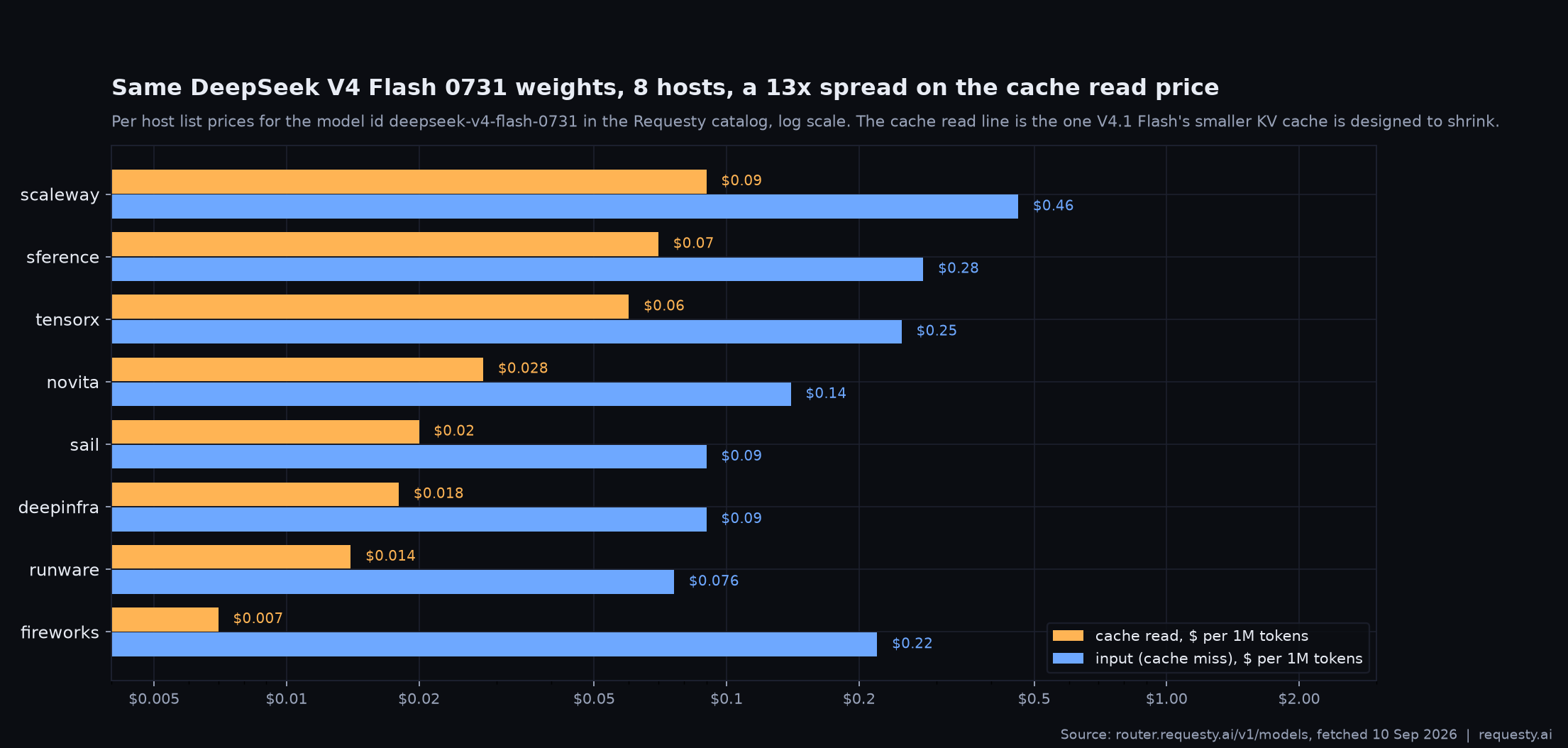
The second variable is the host. Open weights under MIT mean V4.1 Flash will appear on every inference provider within days; on launch day it was already live on the Vercel AI Gateway and via Novita on OpenRouter. In the Requesty catalog, the first party route deepseek/deepseek-v4.1-flash and novita/deepseek-v4.1-flash both list at $0.30 in, $1.20 out and $0.006 per cache read. That agreement will not last, because it never has. Here is the same catalog for the previous Flash release:
| Host | Input, $ per 1M | Output, $ per 1M | Cache read, $ per 1M |
|---|---|---|---|
| fireworks | 0.22 | 0.66 | 0.007 |
| runware | 0.076 | 0.153 | 0.014 |
| deepinfra | 0.09 | 0.18 | 0.018 |
| sail | 0.09 | 0.18 | 0.02 |
| novita | 0.14 | 0.28 | 0.028 |
| tensorx | 0.25 | 0.30 | 0.06 |
| sference | 0.28 | 0.56 | 0.07 |
| scaleway | 0.46 | 0.93 | 0.09 |
Eight hosts, identical weights, a 6x spread on input and a 13x spread on the cache read price. Cache reads are exactly the line V4.1 Flash's smaller KV cache is designed to shrink, and they are the line where hosts diverge most. On 9 September an r/openrouter user described being routed to a host with a slightly cheaper token price and a much higher cache price, so an agent workload that was mostly cache hits ended up costing more, not less. Whoever picks the host for you needs to price on your traffic mix, not on the input column.
Expect the same for V4.1 Flash: the first party API is the anchor, and within a month the cheapest cache read will be a third party and the fastest route will be a different third party. The provider variance problem does not go away when the model gets cheaper; it gets more consequential because the volumes get larger.
What the launch pattern tells you about the next one
The 70 mention curve above has a shape worth remembering. Mentions started on 8 September, two days before the announcement, when people noticed a deepseek-v4.1-flash id live on the API at the old Flash price. On 9 September a small account documented a two day burner id, deepseek-v4.1-flash-expires-on-0910, an intermediate checkpoint with a 20 request concurrency cap that shut itself off on launch day. Then the announcement, then the price cut, then the Pro retirement.
This is now DeepSeek's established cadence: ids appear before announcements, some ids carry expiry dates in their names, and old ids get redirected rather than deleted. We wrote about the free model ids with expiry dates pattern in August, and about the stealth launch class of event before that. V4.1 Flash combines both with a third: retirement by redirect, where the id survives and the model behind it does not.
A one line counterweight, because the corpus contains it: Ethan Mollick argued on 9 September that open weights models are further from the frontier than we have seen in some time, with K3 and GLM-5.3 good but not close to Mythos or Astra in practice. V4.1 Flash is a cheaper, faster, smaller active footprint model. It is not a claim on the frontier, and its price is the reason it matters.
What to do before Monday
- Find every place
deepseek-v4-prois pinned. Configs, prompt registries, eval fixtures, fallback chains. If you pass it through a gateway, filter your logs on the model field; that list is the blast radius. - Run your private evals against V4.1 Flash now, not on 15 September. Public benchmarks do not predict your workload and the vendor table is a vendor table. If V4.1 Flash passes, switch deliberately and take the price cut. If it does not, you need a different Pro class model in place before the redirect, because there will be no V4 Pro to fall back to.
- Put 14 September 04:00 UTC on your deprecation calendar next to your other vendor dates. Treat vendor redirects like deprecations: they change model behaviour on a date you did not choose.
- Choose the host on your traffic mix. If your workload is agentic and cache heavy, the cache read column decides the bill, and the spread on that column for the previous Flash release was 13x. Use a fallback policy that spans at least two hosts of the same weights so a capacity error on one, like the 429s reported through OpenRouter on launch afternoon, does not take the workload down.
- Schedule what can wait into off peak. Batch evaluation, backfills and overnight agent runs cost half as much outside 01:00 to 04:00 and 06:00 to 10:00 UTC on weekdays. This is free money for anything that is not latency sensitive.
Requesty already lists deepseek/deepseek-v4.1-flash and the per host variants as they come online, with the served host and price in every log line, so you can see exactly which model answered a request the morning a redirect lands. The model page tracks the live price, and the cheapest model rankings will show where V4.1 Flash sits once the hosts diverge. If the question is who is allowed to adopt the new model and on whose budget, that is the per agent identity problem, covered separately this week.
The takeaway
V4.1 Flash is what the open weights ecosystem is best at: a large, cheap, permissively licensed model that a dozen hosts will serve within weeks, priced at a fraction of the closed flagships. The community reaction is right to be positive.
But the release note also retires three model ids by pointing them at a model none of them were tested with, on four days' notice, and describes this as a feature. The teams who come out ahead on Monday are the ones who treat a model id as a promise the vendor can revoke, evaluate the replacement before the date, and route through a layer that shows them which model served each request. Everyone else finds out from a customer.
Frequently asked questions
- What is DeepSeek V4.1 Flash?
- V4.1 Flash is the first model in DeepSeek's new architecture family, released on 10 September 2026 under an MIT licence. It is a 552B parameter mixture of experts with a causal encoder decoder design that activates 8B parameters on input and 16B on output, adds native image understanding, and ships a 1M token context window. DeepSeek says its KV cache needs a quarter of the HBM and an eighth of the SSD storage of the previous generation.
- What happens to deepseek-v4-pro on 14 September 2026?
- According to DeepSeek's release note and pricing page, from 04:00 UTC on 14 September 2026 all requests to deepseek-v4-pro are routed to V4.1 Flash and billed at V4.1 Flash rates, until a V4.1 Pro is released. The legacy ids deepseek-v4-flash and deepseek-v4-flash-vision-exp already route to V4.1 Flash. The recommended model name is deepseek-flash.
- How much does DeepSeek V4.1 Flash cost?
- On the first party API, V4.1 Flash costs $0.15 per million input tokens and $0.60 per million output tokens off peak, doubling to $0.30 and $1.20 during peak hours, which are 01:00 to 04:00 and 06:00 to 10:00 UTC on weekdays. Cache hits cost $0.003 off peak and $0.006 at peak. Third party hosts list their own prices, and for the previous Flash release those ranged 13x on the cache read line alone.
- How do I protect production from a model id being redirected?
- Pin to dated ids where the vendor offers them, run your own eval harness against the new target before the switch date, keep a fallback chain that includes another host of the same weights, and put vendor retirement dates on the same calendar as your deprecations. A gateway makes the redirect visible because the served model shows up in every log line.
- SEP '26
The list price is now a range: peak hours, promo windows and host floors
In August the frontier rate card stopped being a number. DeepSeek bills V4 Pro at $1.32 input during seven weekday hours and $0.66 the rest of the time. OpenAI cut GPT-5.6 Sol to $4 and $20 but only through 21 November. Gemini 3.8 Flash doubles on 1 January. And the cheapest GPT-4-class price in the market is set by a reseller, not by the lab. Your cost model needs a clock, a calendar and a host column.
- JUL '26
Same weights, twelve providers, 4.8x price gap: the provider variance problem
On July 20 the same DeepSeek V4 Pro weights were listed across twelve providers from $0.44 to $2.10 per million tokens. Open weights did not commoditize inference, they moved the variance from the model to the provider. Here is how to route for it.
- SEP '26
GLM-5.3 Flash vs DeepSeek V4 Flash 0731: which flash model fits your API workload?
GLM-5.3 Flash brings vision and stronger agentic scores; DeepSeek V4 Flash 0731 starts responding three times sooner. Which flash model fits your API workload?
- AUG '26
Free model IDs now ship with expiry dates: how to use promotional inference without building on sand
In one week: a stealth model gave away 20 trillion tokens then vanished, Thinking Machines put Inkling on OpenRouter free for a few weeks, MiniMax opened M3 and M2.7 free until 6 September, and Z.ai handed 50,000 developers 100M tokens each. Free inference is now a marketing channel with a calendar. Here is how to consume it without a production incident.
- SEP '26
Record on Terminal-Bench, catastrophic on a private eval: Fable 5.1 and the case for your own benchmark
Fable 5.1 more than doubled its predecessor on Terminal-Bench-Science and jumped 14 points on Terminal-Bench 4.0. A developer who runs a private trap laden stress test against every Claude release recorded the worst result they had ever seen. Both observations are real, which is the argument for owning an eval set.
- JUL '26
Opus 5, Grok 4.6, GPT-6 rumors: shipping through the model release treadmill
Claude Opus 5 landed this week, Grok 4.6 is two weeks out, GPT-6 is rumored inside six, and DeepSeek and GLM keep shipping. If every launch costs you an engineering week, the problem is your architecture, not the release cadence.