
Every model comparison leads with input and output price. There is a third rate that decides what an agent costs, and almost nobody compares it.
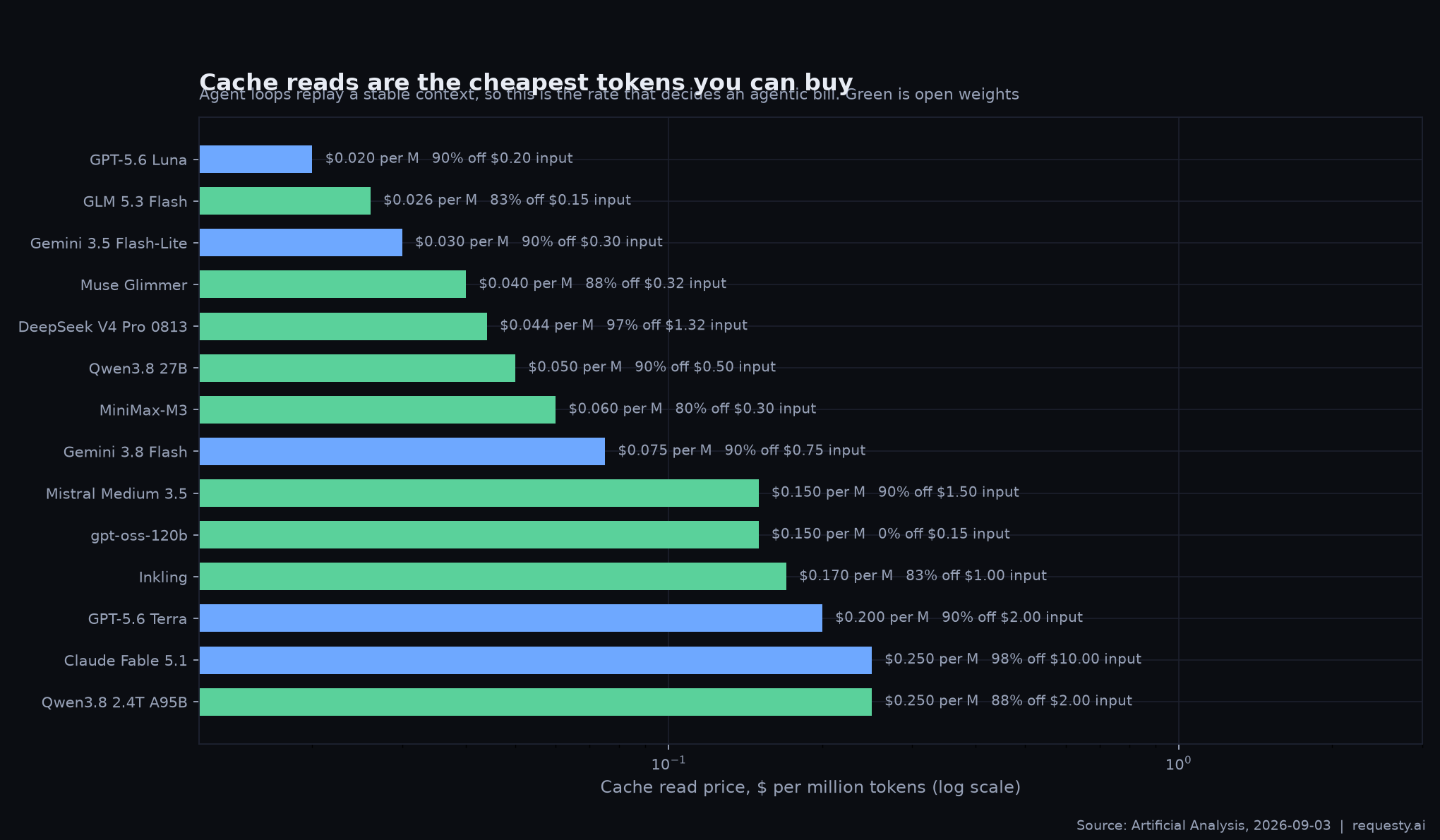
On the 2026-09-03 Artificial Analysis snapshot, Claude Fable 5.1 charges $0.250 per million tokens for cache reads against $10.00 for fresh input, a 98% discount. At the other end, gpt-oss-120b lists cache reads at $0.150 per million, exactly its fresh input price, so there is no discount at all.
For an agent replaying a long transcript on every turn, that difference is most of the bill.
The comparison
| Release | Fresh input per 1M | Cache read per 1M | Discount |
|---|---|---|---|
| GPT-5.6 Luna | $0.20 | $0.020 | 90% |
| GLM 5.3 Flash | $0.15 | $0.026 | 83% |
| Gemini 3.5 Flash-Lite | $0.30 | $0.030 | 90% |
| Muse Glimmer | $0.32 | $0.040 | 88% |
| DeepSeek V4 Pro 0813 | $1.32 | $0.044 | 97% |
| Qwen3.8 27B | $0.50 | $0.050 | 90% |
| MiniMax-M3 | $0.30 | $0.060 | 80% |
| Gemini 3.8 Flash | $0.75 | $0.075 | 90% |
| Mistral Medium 3.5 | $1.50 | $0.150 | 90% |
| gpt-oss-120b | $0.15 | $0.150 | none |
| Inkling | $1.00 | $0.170 | 83% |
| GPT-5.6 Terra | $2.00 | $0.200 | 90% |
| Claude Fable 5.1 | $10.00 | $0.250 | 98% |
| Qwen3.8 2.4T A95B | $2.00 | $0.250 | 88% |
| GLM-5.3 | $1.40 | $0.260 | 81% |
| Kimi K3 | $3.00 | $0.300 | 90% |
| GPT-5.6 Sol | $4.00 | $0.400 | 90% |
| Claude Opus 5 | $5.00 | $0.500 | 90% |
Two observations change how you should read a price list.
The expensive model has the cheapest cached tokens relative to itself. Claude Fable 5.1 costs 50x more than GLM 5.3 Flash on fresh input, $10.00 against $0.15, but only about 10x more on cache reads, $0.250 against $0.026. The more of your input that is cached, the more the headline gap overstates the real gap.
90% is the convention, not the rule. Most providers cluster at exactly 90%, which makes the outliers the interesting part: 98% and 97% at the top, and 80%, 75%, 63% and zero at the bottom. If you assumed a 90% discount across your candidates, you mispriced several of them.
Why this rate dominates agent bills
A chat request sends a short prompt once. An agent sends the entire accumulated transcript on every single turn, so the same prefix is re-read dozens of times in one task. Input volume grows quadratically with turn count while the output stays small.
That is why the cache read rate, not the output rate, sets the bill for agentic work, and why the same model can look cheap for chat and expensive for agents. We covered the mechanics of how each provider implements this in the cross provider caching deep dive.
The corollary is uncomfortable: a discount you do not qualify for is worth nothing. Cache hits require a stable prefix. If you rotate a timestamp, a session id or a shuffled tool list into the top of your context, you invalidate the prefix and pay the fresh rate on every turn, no matter what the price list says.
What to do
Check the third rate before you commit. Add cache read price to your comparison table alongside input and output. For agent workloads, weight it highest.
Verify you are hitting cache at all. Providers report cached token counts per request. If your cached share is low on a workload that replays context, the problem is prompt construction, not price. Requesty analytics exposes the per request token breakdown so you can confirm rather than assume.
Keep the prefix stable. Put everything static at the top, system prompt, tool definitions, retrieved context, and everything variable at the bottom. Sort anything you build from a dictionary so its order does not change between turns.
Route on the blended rate, not the headline. Once cache reads are priced in, the ordering of candidates changes for agentic traffic. That is a routing decision, and routing by cost is how you act on it without rewriting an integration.
Caveats
These are list prices from a single 2026-09-03 snapshot, and they move. Cache write prices are a separate line item that several providers charge and Artificial Analysis does not publish for every model, so a large read discount can be partly offset by write costs on workloads that constantly build new prefixes.
Cache lifetime also varies by provider, from minutes to hours, and a cache that expires between turns bills as fresh input. A published discount is a ceiling on your saving, not a floor.
Finally, no discount rescues a bad fit. A model at 98% off that needs three attempts to complete a task costs more than one at 80% off that succeeds first time, which is the argument for measuring cost per task rather than cost per token.
Frequently asked questions
- What is a cache read and why is it cheaper?
- When you resend a prefix the provider has already processed, it can reuse the computed attention state instead of recomputing it. Providers pass part of that saving on as a reduced input rate, called the cache read or cache hit price.
- Which model has the largest cache read discount?
- On the 2026-09-03 Artificial Analysis snapshot Claude Fable 5.1 charges $0.250 per million for cache reads against $10.00 for fresh input, a 98% discount. DeepSeek V4 Pro 0813 is close behind at 97%.
- Do all providers discount cache reads?
- No. On the same snapshot gpt-oss-120b lists a cache read price of $0.150 per million, identical to its fresh input price, so there is no discount at all. Nemotron 3 Ultra discounts 63% and Grok 4.6 discounts 75%, well below the 90% that is common.
- Does a big cache discount guarantee a smaller bill?
- Only if your workload replays a stable prefix. Chat shaped traffic with short varied prompts gets little benefit. Long agent loops that resend a growing transcript benefit the most, which is why the discount matters far more for agents than for chat.
- JUL '25
Cross-Provider Caching Deep Dive: Maximize Performance Across Your Stack
- JUL '26
Cheapest LLM API Prices Compared (2026): Provider by Provider Cost Guide
A live, provider-by-provider comparison of LLM API prices in 2026: input and output cost per million tokens across the models teams ship most, plus where a gateway is cheaper than going direct. Includes the flex-tier models where Requesty runs half the price of OpenRouter.
- JUN '26
AI Agent Cost Optimization: How to Cut LLM Spend by 80% with Routing
AI agents generate 10x to 100x more tokens than chatbots. Without optimization, inference costs dominate your cloud bill. This guide covers the four techniques that cut agent spend by 60 to 80 percent: model routing, prompt caching, context management, and budget caps.