
A gateway sees something application code never gets to see: the full shape of an agent run, from the first call to the last, across thousands of teams at once. We group related requests into a trace, and once you can count the calls in a trace you can answer a question most people only guess at. How autonomous is AI usage in 2026, and how deep does a single run go?
The answer is a barbell. Most runs are trivial. A small tail is wild. Both facts matter.
Most runs are one and done
Start with the boring truth, because it grounds everything else. In June, 68% of all traces were a single interaction. Someone asked one question and got one answer. Another 12% chained two or three calls. The classic "chatbot" pattern still dominates by count.
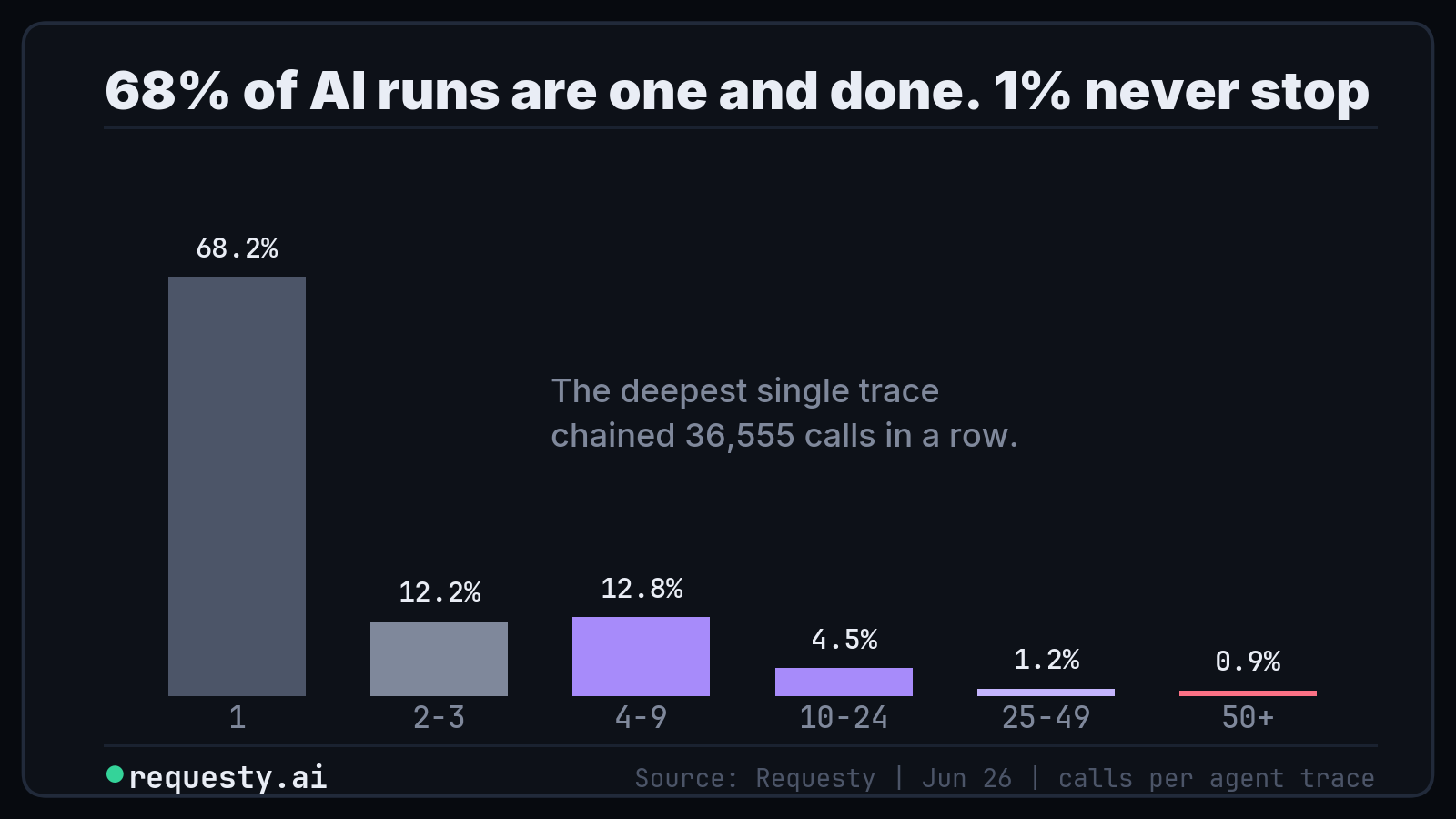
If you only looked at the median, you would conclude that agents are hype and nothing has changed. The median trace depth is 1. That would be the wrong conclusion, because the action is not in the middle of the distribution. It is in the tail.
The tail is where autonomy lives
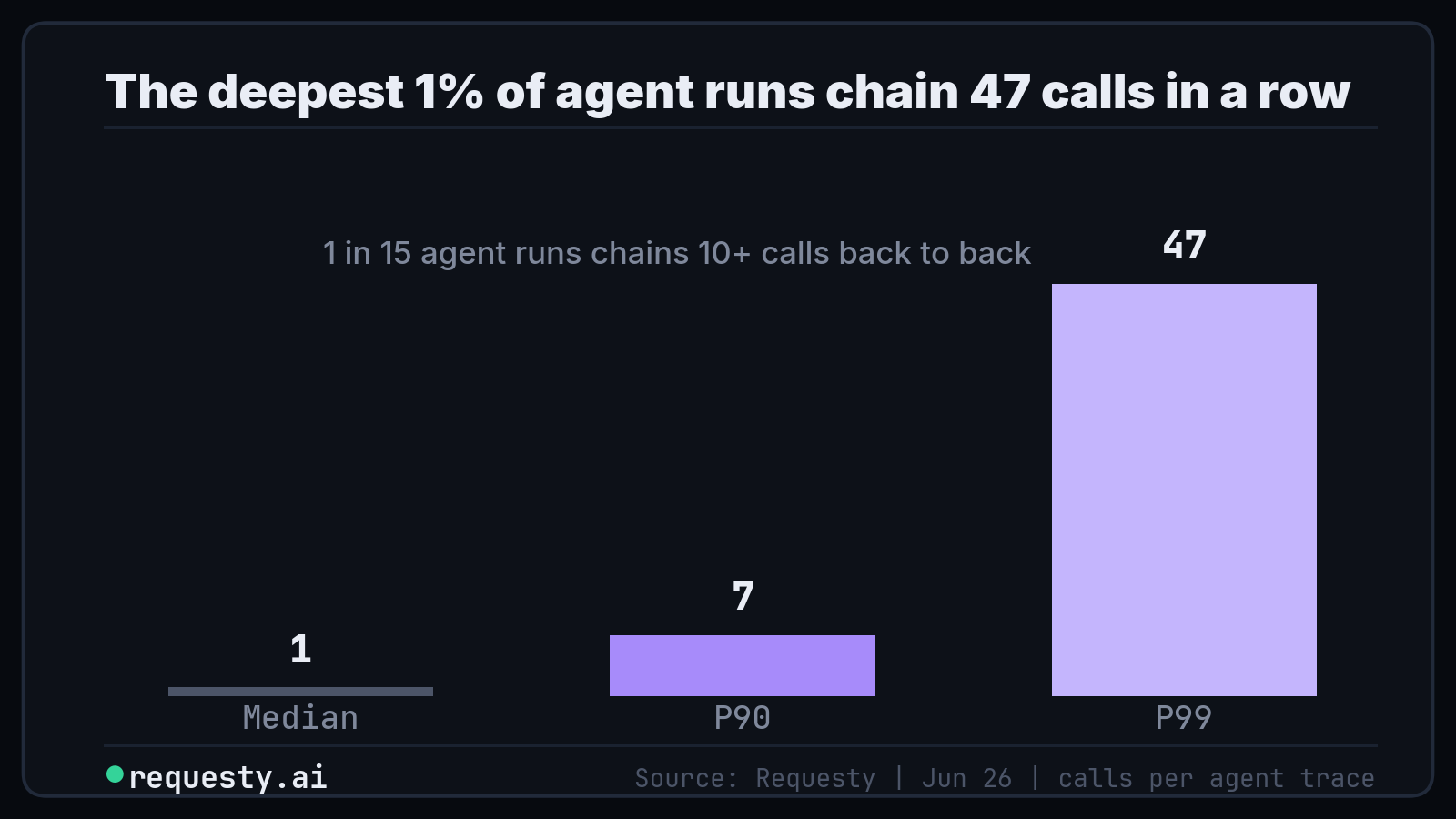
Look at the top of the distribution and a different world appears. The deepest 1% of runs chain dozens of tool calls back to back with no human touching the loop.
And then there is the extreme edge. Every single month, one agent completely loses the plot and runs away.
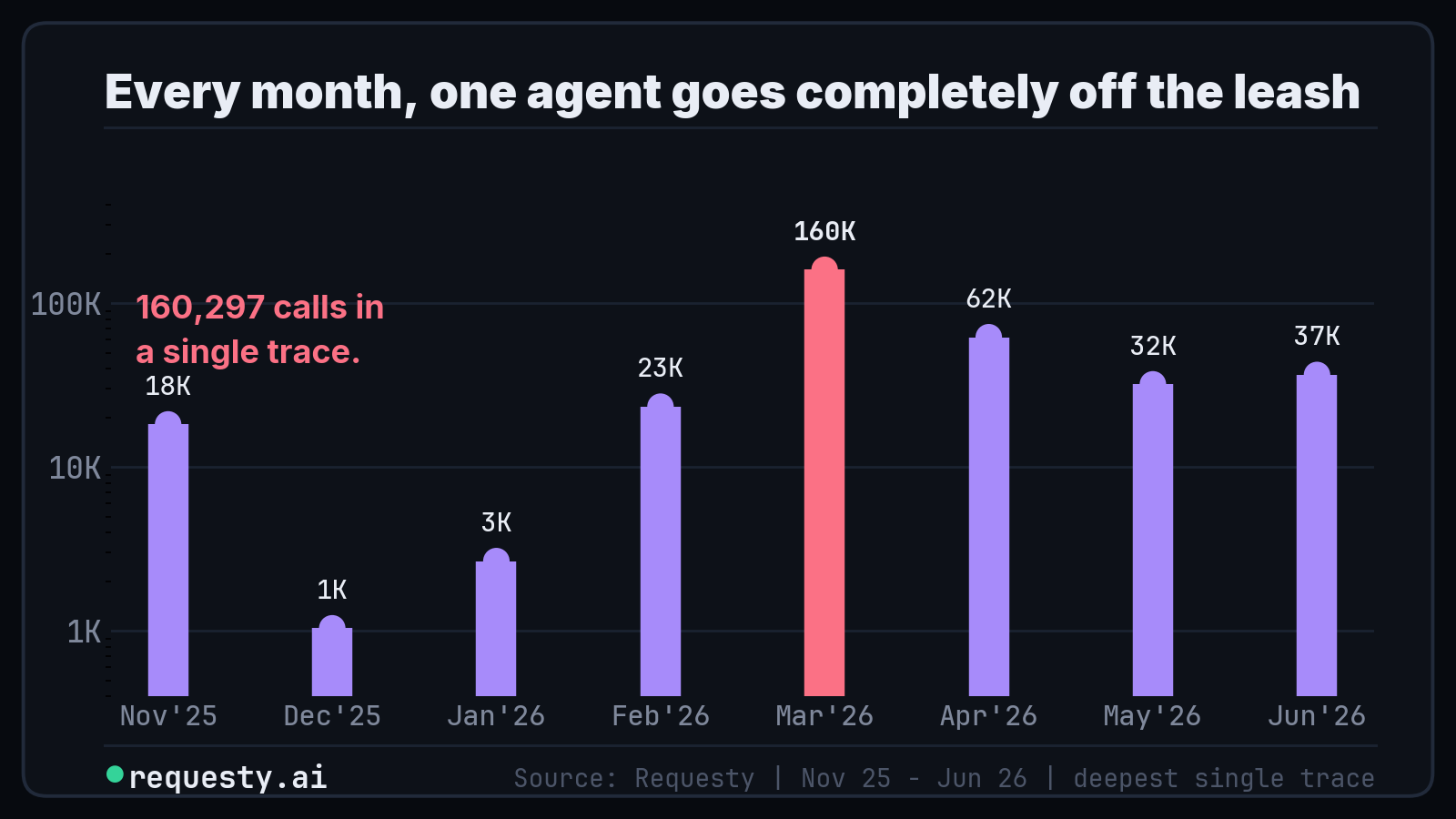
The deepest single trace we have ever logged chained 160,297 model calls in one run. To be clear about what this is: these monthly maxima are single outlier runs, almost certainly a loop that never hit a stop condition. It is not typical behavior and I am not going to pretend it is. But it is real, it happens every month, and it is a preview of a failure mode that barely existed two years ago. When you hand a model a tool and a while-loop, the ceiling on how much it can do unsupervised is a lot higher than most teams have planned for.
How runs end tells you who the model is talking to
There is a second signal hiding in how responses finish. One in four AI responses in June did not end with an answer. It ended by calling a tool.
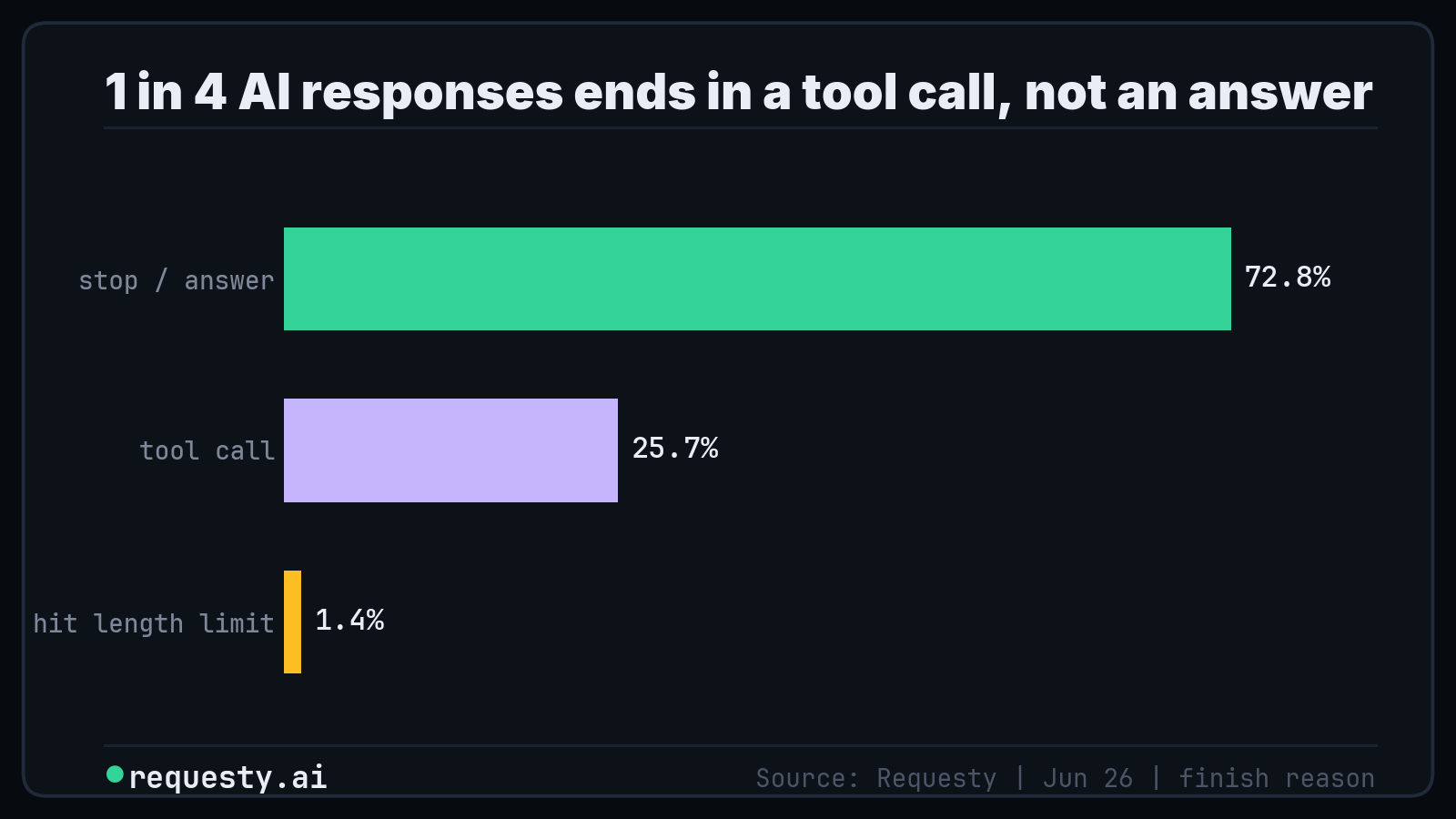
That is the agentic economy in a single chart. A quarter of the time, the model is not talking to a person. It is talking to your software, asking it to run code, fetch a file, or hit an API, and then it keeps going. The one and done traces are humans. The deep traces are agents. The finish reason mix is the seam between the two.
What to do with this
If you are shipping agents, the long tail is your operational risk, not the median. A few things we have learned running this at scale:
- Put a hard ceiling on trace depth. If a run passes a few hundred calls with no human checkpoint, something is wrong and you want to catch it before it becomes 160,000.
- Reconstruct and inspect your deep traces. You cannot debug what you cannot see. Session reconstruction stitches the calls back into one timeline.
- Track your own tool_calls finish rate. It is the cleanest proxy for how agentic a given workload has become. Tool call analytics breaks this down for you.
- Route agent traffic deliberately. Deep runs multiply every reliability and latency problem by the number of calls, so a route that fails 1% of the time will bite you hard at depth. Our take on this is in reliability aware routing.
We publish the per-provider operational cuts, including finish reason mix, on our open data hub at requesty.ai/data.
The headline writes itself: most AI is still one call. But the machines that work unsupervised are working a lot harder than the averages admit, and the tail is getting longer every month.
Building an agent harness? The gateway is the backbone. Start free or read the MCP gateway docs.
- MAY '26
Agent Harness: Why Your LLM Gateway Is the Backbone of Production Agents
The model is the brain. The harness is the body. In 2026 the agent harness has become the critical infrastructure layer for production AI. This post breaks down the stack and shows how an LLM gateway like Requesty fits in with real code examples.
- APR '26
Agentic routing, benchmarked: Requesty adds 16ms of overhead, OpenRouter adds 55ms
Agentic routing is the decision layer inside a multi-agent LLM system that picks which model or sub-agent handles an incoming request. Here's what it does, what it costs, and how the gateways compare.
- JUL '26
Why Traditional Latency Routing Fails and How We Fixed It With One Formula
Traditional latency routers pick the fastest provider. That provider fails up to 60% of requests at night. Here is how Thompson Sampling with a reliability penalty cuts errors by 75% and delivers 35% faster P50 latency, using one self calibrating formula.